-
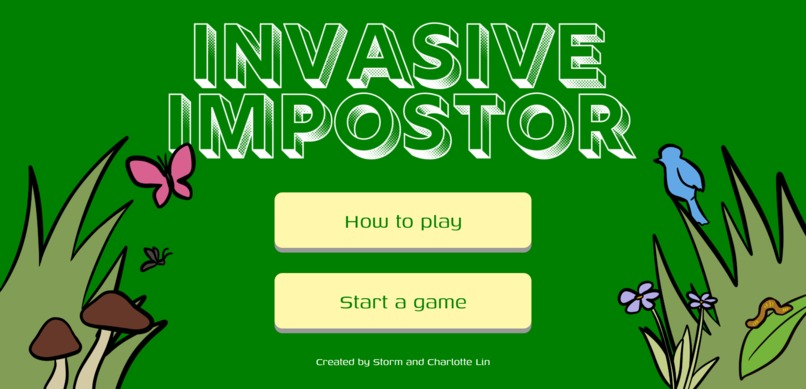
Can you outwit the native species as the invasive impostor?
-
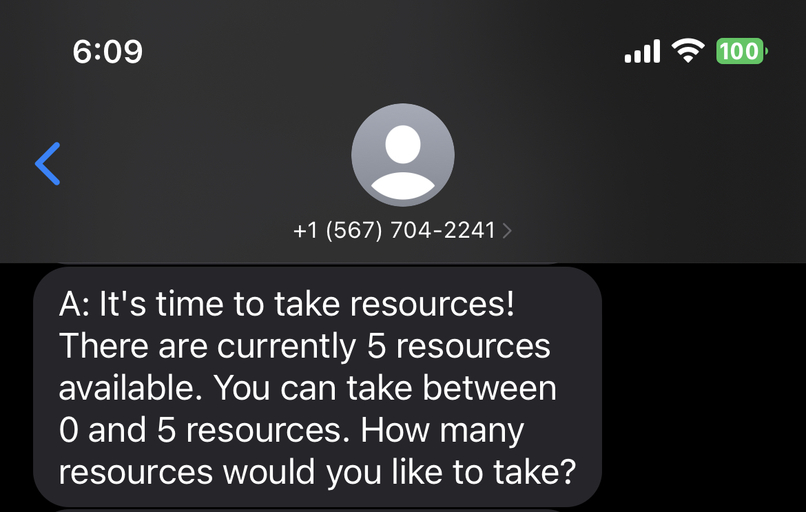
Receive hidden information and make decision by texting on your phone!


Inspiration
We wanted to make a fun online game inspired by the hit game "Among Us", but with an environmentally-minded twist. We also had the idea to involve phones, and have the game be played through texting. We hope this social deduction game will help people learn more about invasive species and their effects, as well as have fun with friends.
What it does
On the Invasive Impostor website, you can create a game with 4 - 10 players. Once you type in the names and phone numbers and start the game, everyone will receive a text with their role assignment: one person will be the "invasive species" and everyone else will be a "native species", and they will have to compete for resources. The native species' goal is to collect enough resources and try to identify and vote out the invasive species, while the invasive species' goal is to starve out the native species until they all go extinct. For full instructions on how to play the game, see the instructions page of the website!
How we built it
We used Node.js and Express.js to build our website, as well as JavaScript, HTML, and CSS. We used the Twilio API to handle sending and receiving texts.
Challenges we ran into
It was a challenge to learn to use the Twilio API and combine it with our existing programming knowledge to make our idea come to life, but we successfully overcame this challenge. It was also a challenge to integrate the back end (Express) and the front end (JavaScript) with each other in the way we wanted.
Accomplishments that we're proud of
Creating a well-designed game with a unique feature and a technological implementation to back it.
What we learned
We learned a lot about web development using Express.js, client-side JavaScript, and the Twilio API and how these can interact with each other.
What's next for Invasive Impostor
We'd like to make the game and website more polished and player-friendly, so that it can reach a wider audience. We'd like to add some more educational content like giving players facts about real invasive species as they play. We'd also like to handle more edge cases in the code, such as allowing people who send a text mistakenly or with a typo to correct themselves.


Log in or sign up for Devpost to join the conversation.