-
-
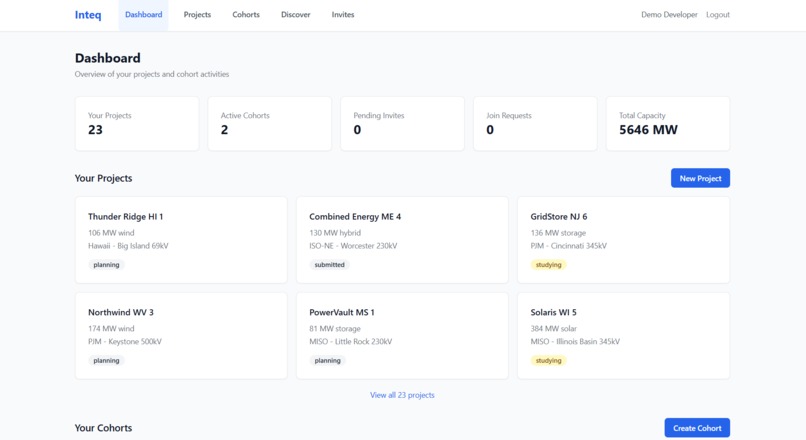
Dashboard
-
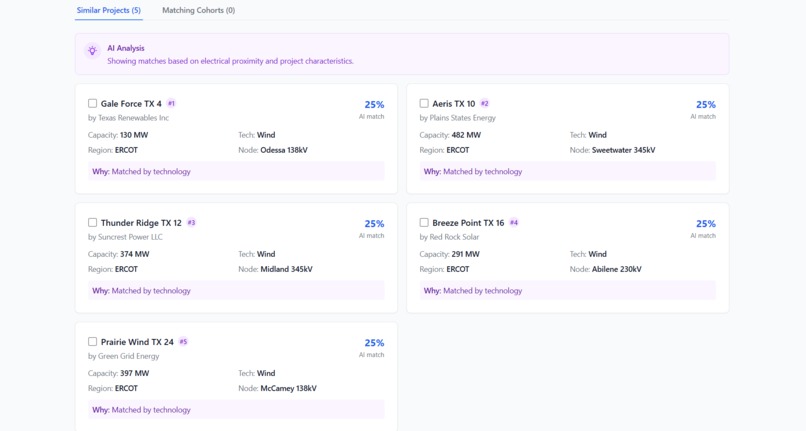
AI analysis
-
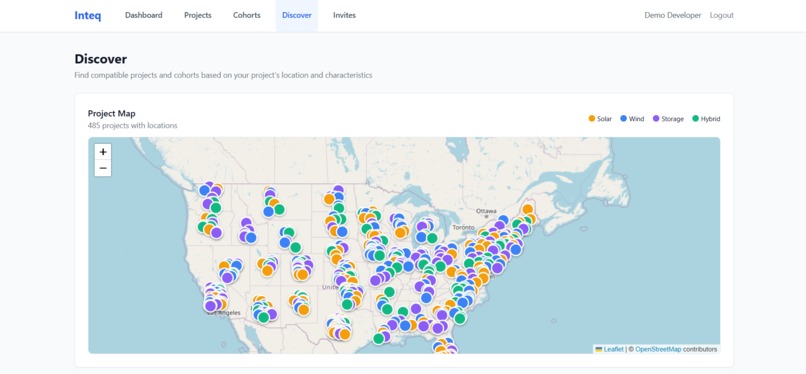
Map feature


Inspiration:
Over 2 terawatts of mostly clean energy projects are currently stuck in U.S. interconnection queues—more than 150% of the nation’s installed generation capacity. Despite record investment in renewables, projects have to wait 3–7 years to connect to the grid, and over half withdraw before ever coming online.
As we dug deeper, it became clear that this bottleneck isn’t caused by a lack of clean energy technology, but by a coordination and regulatory failure in how projects access the grid. Interconnection queues are fragmented, opaque, and punitive to developers who act alone. Inteq was inspired by the idea that projects shouldn’t compete for grid access—they should collaborate.
What it does:
Inteq is a platform that helps clean energy developers coordinate grid interconnection through shared cohorts. It provides a company dashboard where developers can view and manage all of their projects, explore available interconnection cohorts, and interact with a geospatial map of projects and grid assets. Developers can invite other projects to form or join cohorts, review incoming invitations, and collaborate with geographically and electrically compatible projects to share grid upgrade costs.
Inteq reduces redundant interconnection studies and project dropouts by encouraging coordinated entry into the queue, and integrates AI-powered analysis via the Gemini API to recommend well-matched projects for cohort formation based on location, capacity, and queue constraints. By shifting interconnection from a fragmented, first-come-first-served process to a collaborative cohort-based model, Inteq accelerates grid access while lowering cost and risk for clean energy developers.
How we built it:
We built Inteq as a full-stack web application with a React.js frontend and Node.js/Express backend, using MongoDB as our database.
The core of the app is a project discovery and cohort formation system. Developers can register their renewable energy projects with details like capacity, technology type, interconnection node, voltage level, and target COD dates. We built an interactive map using Leaflet and React-Leaflet that displays all projects across the US with color-coded markers by technology type.
For the recommendation engine, we implemented a RAG (Retrieval Augmented Generation) pipeline. When a user wants to find compatible projects, we retrieve candidates filtered by region and electrical characteristics. This context is then passed to Google Gemini, which analyzes the projects and returns intelligent rankings with natural language explanations of why certain projects would make good cohort partners.
Authentication was implemented using Auth0 for social login (Google) alongside traditional email/password auth using JWT tokens.
For deployment, we provisioned a fresh Ubuntu VPS on Vultr and set up a production environment from scratch - installing MongoDB, configuring nginx as a reverse proxy to serve the React frontend and proxy API requests to the Node.js backend, and using PM2 for process management.
We seeded the database with 450+ realistic renewable energy projects distributed across all 50 US states, with weighted distribution reflecting actual renewable energy development patterns (more projects in Texas, California, and the wind corridor states).
Challenges we ran into:
Building Inteq came with many small hurdles—from fragmented ISO data to uncertain upgrade costs and a steep learning curve in grid planning. Each challenge sharpened our approach, steering us to prioritize coordination over prediction and reinforcing our core insight: collaboration is key to faster grid access.
Accomplishments that we're proud of:
We built a working prototype that tackles a nationally recognized bottleneck in the energy sector. By integrating multiple real-world energy datasets into a single platform, we created a foundation for more coordinated grid planning. We also designed a novel cohort-based interconnection model aligned with emerging FERC reforms, translating a complex regulatory problem into a clear, intuitive product. To enhance user experience, we embedded AI-driven analysis that allows users to discover similar projects that may be suitable for them based on factors like location, technology, and grid conditions, making the platform both smarter and more actionable.
What we learned:
Our work reinforced that the clean energy transition is limited more by process and incentives than by technology. Solving infrastructure problems requires system-level thinking rather than isolated optimization, and while public data is powerful, it is often messy—working with it is a skill in itself. Additionally, addressing niche pain points demands deep research rather than assumptions.
What's next for Inteq:
Looking ahead, we aim to expand our cohort logic using historical withdrawal and congestion data, add ISO-facing analytics to support proactive regional transmission planning, and integrate real interconnection cost estimates as they become available. We also plan to explore partnerships with regulators and utilities to pilot cohort-based queues. Our vision is for Inteq to become the coordination layer between clean energy developers and the grid, turning interconnection from a bottleneck into an enabler of the energy transition.
This is just the beginning—we’re excited to see where technology will take clean energy progress next.
Built With
- api
- auth0
- css
- express.js
- gemini
- jwt
- leaflet.js
- mongodb
- mongoose
- nginx
- node.js
- react-leaflet
- react.js
- tailwind
- vite
- vultr


Log in or sign up for Devpost to join the conversation.