-
-
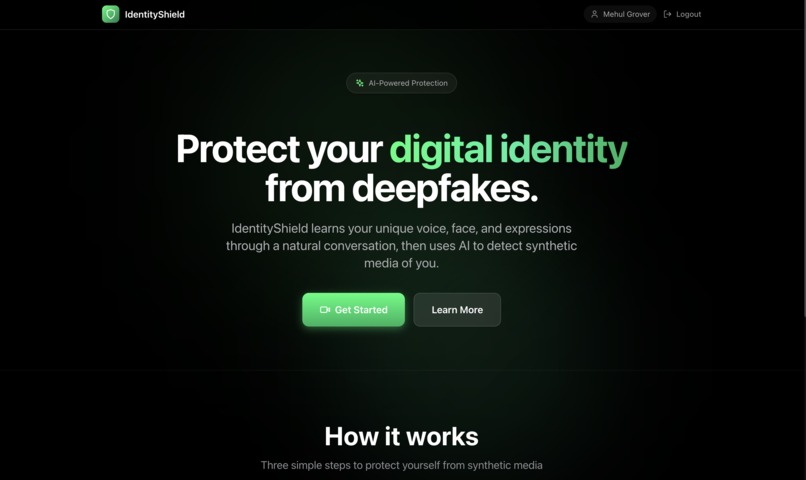
Homepage
-
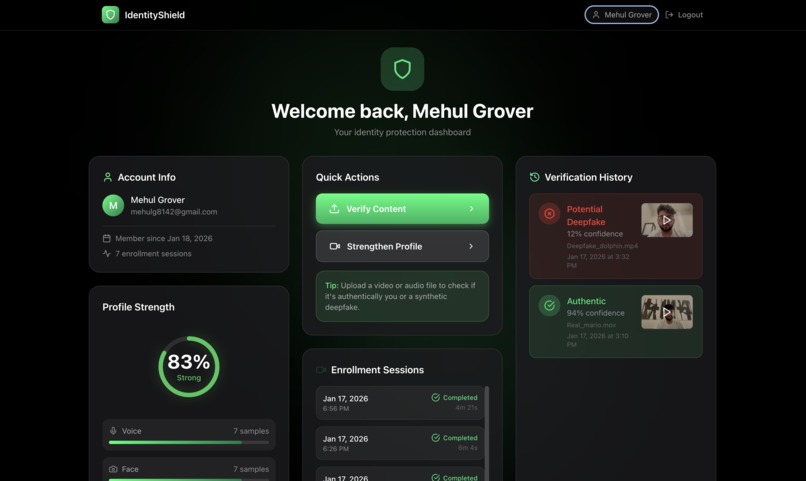
Dashboard


Inspiration
Deepfakes have evolved from obvious fakes to frighteningly convincing impersonations. We saw news stories of CEOs being spoofed for wire fraud, political misinformation, and personal harassment—and realized there was no easy way for individuals to prove a video wasn't them. We wanted to flip the script: instead of detecting deepfakes after the damage is done, let people proactively build a verifiable identity baseline.
What it does
IdentityShield creates your unique biometric fingerprint through a natural 5-minute video conversation. We capture your voice patterns, facial features, and lip-sync behavior. When a suspicious video surfaces, upload it and we'll compare it against your profile across all three channels—returning a confidence score and specific anomaly flags showing exactly what doesn't match.
How we built it
Frontend: React + Vite with real-time video capture using MediaRecorder API Backend: FastAPI handling chunked video uploads and ML orchestration Voice: Resemblyzer neural speaker embeddings (256-dim vectors) Face: DeepFace with VGG-Face model (4096-dim embeddings + emotion analysis) Lip-Sync: Custom correlation analysis between mouth movement gradients and audio energy Conversation: Claude API powers natural enrollment conversations Challenges we ran into Getting the ML models to run reliably was tough—dependency conflicts between DeepFace, TensorFlow, and PyTorch. Real-time video chunking in the browser while maintaining quality required careful tuning. The biggest challenge was calibrating thresholds: too strict meant false rejections, too lenient meant missed deepfakes.
Accomplishments that we're proud of
Multi-modal verification that requires fooling voice, face, AND lip-sync simultaneously Non-reversible embeddings that protect user privacy (can't reconstruct original video) Natural enrollment through conversation rather than awkward "turn your head left" prompts Anomaly detection that catches subtle tells like "suspiciously perfect" lip-sync What we learned Deepfake detection is an arms race—no single biometric is foolproof. Combining independent channels exponentially increases the difficulty for attackers. We also learned that user experience matters as much as accuracy; people won't enroll if the process feels invasive or tedious.
What's next for IdentityShield
Mobile app for on-device enrollment API for platforms to verify user-submitted content Continuous learning to update profiles as voices/appearances naturally change Integration with social platforms to flag potentially fake content before it spreads
Log in or sign up for Devpost to join the conversation.