-
-
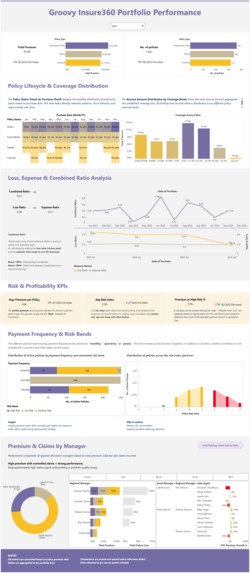
A full-fledged portfolio performance dashboard view
-
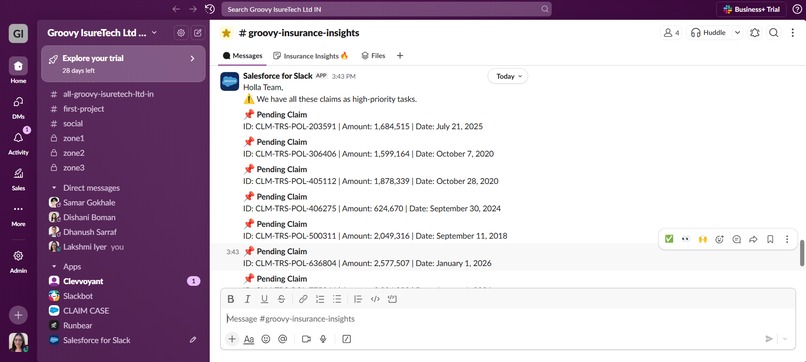
Slack Integration


🌟 What Inspired This Work
For the past month, I have been tasked with creating learning materials for team members to explore opportunities in the insurance field for my company. We provide analytics solutions across various domains and are looking to expand into insurance. During my research, I discovered that many business leaders managing large volumes of policy, claims, agent, and customer data often struggle with their data transformation journeys. They frequently switch between tools to understand performance, making it challenging to interpret data and monitor their team's effectiveness.
I aimed to address this critical gap between data visibility and decision-making. This inspired me to envision a future where analytics not only answers questions but also drives actionable outcomes.
🧠 Project Story—Groovy Insure360
Groovy Insure360 is a unified analytics and action platform built for insurance leaders, designed to turn fragmented data into timely insights and workflow-triggered actions.
The core idea is simple but powerful:
- Data alone is not enough—insights must arrive in time, and actions must happen where decisions are made.
- By leveraging Salesforce Data Cloud’s semantic layer, Tableau Next analytics, and Slack + Salesforce workflow automation, Groovy Insure360 delivers a single, governed source of truth and brings analytics directly into business workflows.
📚 What I Learned
This project was a journey of discovery in several dimensions:
✅ Conceptual Learning
- How semantic layers translate raw facts into business meaning
- How governed metrics ensure consistency across analytics and workflows -The role of real-time data synchronization in operational decision-making
🛠 Technical Learning
- Configuring BigQuery → Salesforce Data Cloud ingest streams
- Creating and managing Data Models (DMOs) for fact and dimension integration
- Building calculated metrics and Level of Detail (LOD) expressions
- Orchestrating Slack workflows that trigger Salesforce actions and vice versa
🏗️ How I Built It
Here’s an overview of how Groovy Insure360 came together:
1️⃣ Data Preparation & Ingestion
- All source data—policies, claims, agents, regional hierarchies—originated as .csv files. To ensure flexibility for updates and future scalability, I first uploaded the datasets to Google BigQuery.
- Then, I configured an authenticated BigQuery connector inside Salesforce Data Cloud to establish a live data stream. Over 11 streams were defined, representing each dataset.
2️⃣ Semantic Modeling — Single Source of Truth
In the semantic layer, I defined Data Model Objects (DMOs) like - Policy: central fact table - Claims: linked via policy keys - Manager/Agent hierarchies: as dimensions - Time & Region: supporting multi-granular analysis Relationships were modeled to reflect real business associations: For example, each policy links to a regional manager, and each claim associates back to a policy.
3️⃣ Dashboarding with Tableau Next
Once the semantic layer was defined, I connected Tableau Next to the governed data model. In the workspace, I designed a one-page executive dashboard optimized for senior managers:
- Top KPIs: Total premium, policy count, quarter-over-quarter changes
- Premium heatmap: Month × Policy Status matrix
- Risk index distribution: Analysis across payment methods and risk bands
- Agent & manager performance: Identifying high-risk portfolios
I used approximately 30+ calculated fields, including Level of Detail (LOD) expressions, to ensure the right level of aggregation and historical comparisons.
4️⃣ Slack Integration & Workflow Automation
To embed insight into where work happens, I integrated Slack with Salesforce workflows:
First Flow:
- A “Send Pending Claims Info to Teams” action triggers a Slack workflow
- Claims pending action are posted into a dedicated Slack channel Users can invoke Salesforce workflows directly from Slack
Second Flow:
- Creating a case record in Salesforce from Slack inputs and executing salesforce workflows through slack workflow
🧗 Challenges Faced
This project featured a blend of technical and conceptual challenges:
⚠️ Data Modeling Complexity
- Translating siloed .csv files into a unified semantic model
- Ensuring consistency and referential integrity across dimensions
🧮 Advanced Calculations
- Deriving meaningful risk indexes and historical comparisons
- Balancing performance vs. accuracy in dashboard computations
🤖 Prompt Engineering
- Not every conversational prompt yielded valuable intelligence. It required iterative refinement to - ensure clarity and relevance.
🔄 Workflow Integration
- Orchestrating Slack workflows with Salesforce actions required deep coordination between platforms, especially with permission controls and conversational UX.
🚀 Future Direction
Groovy Insure360 has a strong foundation, but there’s more to unlock:
- Predictive modeling with time-series and risk forecasts
- Fraud detection signals using AI agents
- Auto-adjudication workflows for common claim types
- Extending the semantic layer to internal and external data sources (e.g., sensor data, telematics)
- Personalized alerts via Slack, SMS, and Salesforce mobile
The vision is a continuously learning insurance operations platform, where insight fuels action, and action improves insight.
Built With
- google-bigquery
- runbear
- salesforce
- slack
- sql
- tableau-next
- workflow



Log in or sign up for Devpost to join the conversation.