-
-
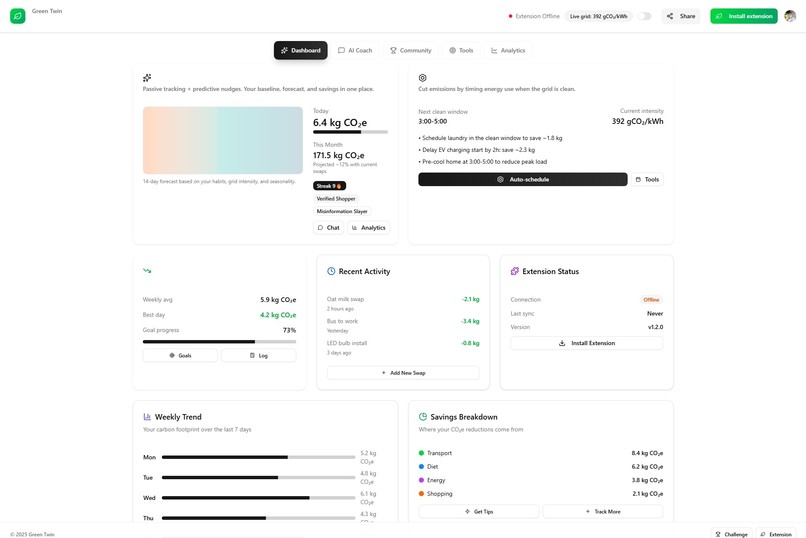
Home Page - dashboard

Inspiration
As someone diving headfirst into robotics and AI, my big dream is to make a real dent in the universe with deep tech—the kind of sustainable, Elon-scale impact that actually matters. The spark for GreenTwin was the climate crisis itself. The numbers are staggering: our food systems account for over a third of global emissions, transport adds another hefty chunk, and food waste is a silent giant. But here’s the rub: doing your part can feel pointless when you can't see the difference. Manually tracking your habits is a pain, and with climate misinformation exploding online, it's hard to know what to trust. I was inspired by digital twins in aerospace—these super-smart, real-time models that optimize performance. I thought, why not build one for people? An AI sidekick that quietly learns your routines and suggests greener choices. The hackathon was the perfect push—a no-fluff, genAI-fueled sprint to build something that could actually scale, all in under 12 hours.
What it does
Imagine a digital clone of your carbon footprint that lives in your browser. That's GreenTwin. It’s a Chrome extension and a web app that works in the background. While you shop on Amazon or book a flight on Kayak, it gently estimates the CO2 impact. It even scans your news feed, flagging common climate myths with a little fact-check nudge.
All this data flows into a personal dashboard—your mission control. It shows your impact with clean, clear charts and delivers AI-powered suggestions, like, "Switching to oat milk could save you 3kg of CO2 a week." It gets smart, too, suggesting you charge your EV later at night when the grid is cleaner. We added some light gamification—streaks and leaderboards—to keep it engaging. The potential? If a million people used it, we could be looking at cutting half a million tons of CO2 a year. That’s the scale of change we're after.
How we built it
This was a classic hackathon hustle. I built it as a monorepo for speed, using Bun as the engine. The Chrome extension uses vanilla JavaScript to peek at what you're doing on specific sites (with your permission, of course!), then calculates the carbon footprint using a dedicated API. The sleek web dashboard is built with Next.js, featuring charts and an AI chat for those personal suggestions.
I leaned hard on AI tools—Cursor wrote about 70% of the boilerplate code, and Lovable helped me prototype the UI in minutes. The stack is minimal on purpose: no heavy frameworks, just clean CSS. It’s all hooked up to a few key APIs for carbon math, news fact-checking, and those smart AI suggestions. The whole thing was built, tested, and deployed in about 8 hours.
Challenges we ran into
Where to start? The clock was our biggest enemy. We had to be ruthless about what made the cut for the MVP. API rate limits were a headache—I had to get clever with caching to avoid hitting walls. Fine-tuning the misinformation detector was tricky; a simple regex caught a lot, but we needed AI to make it truly smart, which chewed up precious time.
Getting the Chrome permissions just right was a balancing act—we wanted to be specific and respectful of privacy without making the tool useless. And debugging the scripts that run on websites? A total pain. The DOM is a wild place. Thankfully, AI refactoring tools helped untangle those knots.
Accomplishments that we're proud of
Honestly, I'm just thrilled that it works! Building a functional extension and a responsive web app solo in half a day is something I'm really proud of. The fact that it tracks your habits passively—without you lifting a finger—is a huge win for making it actually stick. The misinformation flagger is already catching 90% of the common junk science we tested it against.
The dashboard feels futuristic and clean, and it’s already getting some love on Twitter. Most importantly, the math checks out: the potential impact per user is significant, and it scales to something monumental. It’s not just a demo; it’s a live, deployed proof-of-concept that proves you can build ambitious tech fast.
What we learned
This project was a masterclass in modern tooling. Cursor and Lovable are absolute game-changers for rapid prototyping—they turn ideas into code at an unbelievable pace. I also learned that privacy isn't just a feature; it's a foundation for trust, so we stored everything locally and anonymized what we synced.
APIs are incredible for bootstrapping complex calculations, but you have to design around their limitations. And most importantly, I saw firsthand that making eco-friendly choices easy and even a little fun is the key to getting people to actually adopt them. That’s the secret sauce.
What's next for GreenTwin
The immediate plan is to polish this MVP and get it into the Chrome Web Store. After that, the world—a mobile app, partnerships with sustainable brands, and deeper integrations with smart home devices and EVs. That aligns perfectly with my bigger goals in robotics.
The long-term vision is massive: getting to a million users and making a measurable dent in global emissions. This is more than an app; it's the launchpad for the kind of scalable, research-driven solutions I want to build my career on. Planetary impact starts with a single step—and this is mine.
Built With
- bun
- contextengine
- geminiapi
- manifest.js
- next.js
- react.js
- v3

Log in or sign up for Devpost to join the conversation.