-
-
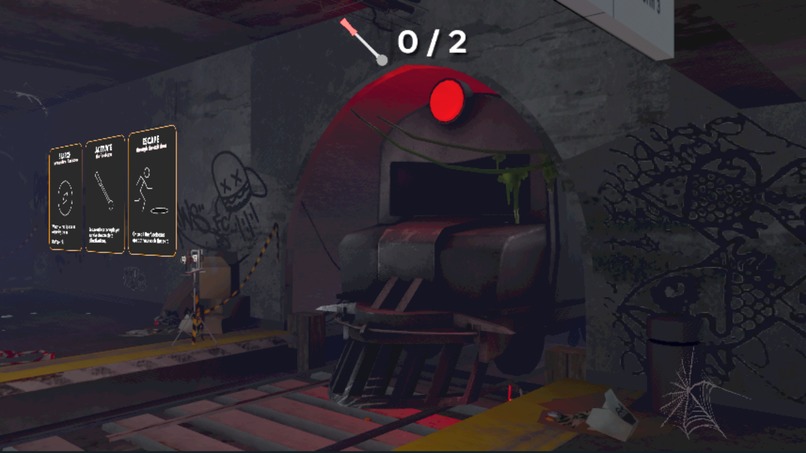
Moving train in lobby that organically introduces the player to the core mechanic within first 3 seconds, without need for any instructions
-
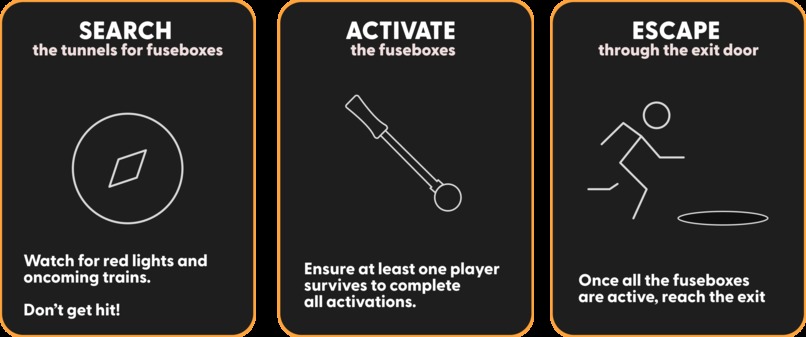
Instruction panel that further introduces core loop.
-
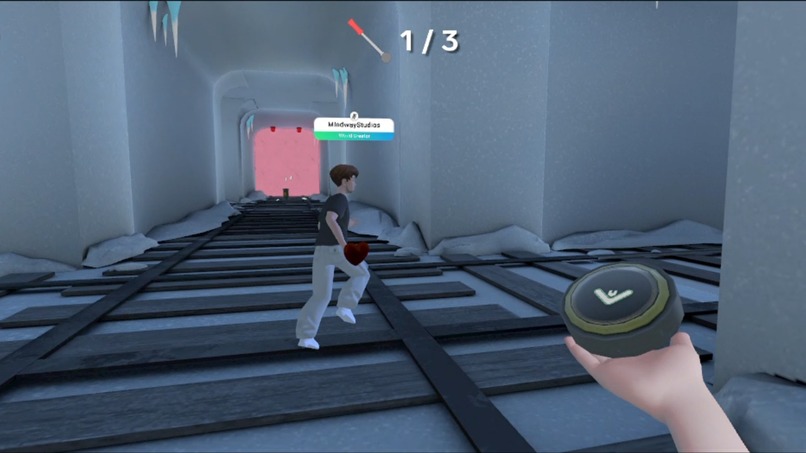
Two players collaborate to find the fuseboxes without getting hit by trains, one carrying a compass and the other carrying an extra life.
-
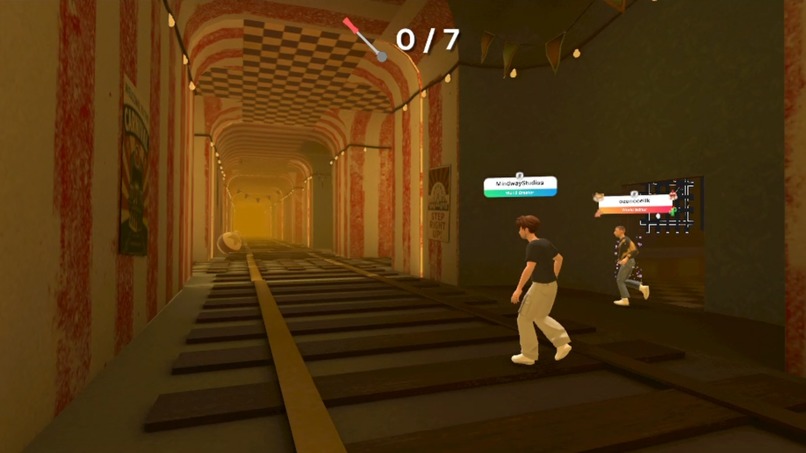
Two players search one of the 10+ differently themed levels, that keeps the game aesthetically interesting
-
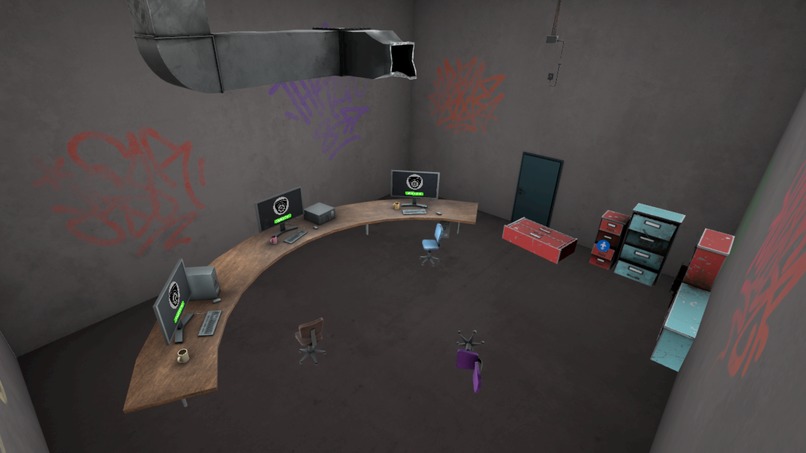
CCTV room for players who have been eliminated to watch and talk to players who are still in the game to help them out while staying engaged
-
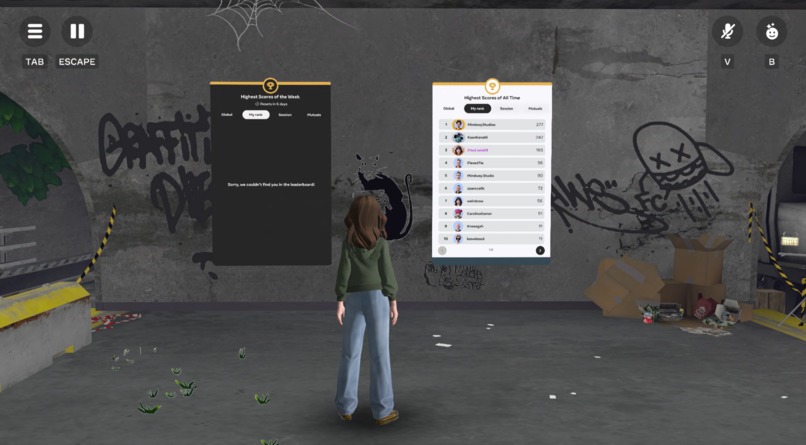
A weekly highscore board accompanying the all-time board encourages retention by giving players a higher chance to see their name on a list


Inspiration
Many Horizon creators often suffer from the same dilemma: they want to build something large scale that feels almost like a Quest or console game, but keeping the scale small is often the only way to create something that performs well. So we thought - what if we built a game that feels massive and endless, but that is composed at the most basic level of small-scale building blocks. And so, Go Far, a procedurally generated, highly unique adventure / infinite runner game, was born based on the following premise:
In the early 2000s, the government launched the Subnet Project - a classified transit network meant to connect military and research facilities across the country. But after a series of unexplained disappearances, the entire system was quietly shut down and buried from public record. Years later, you and a small group of urban explorers have uncovered the entrance. As you descend into a system designed for speed and secrecy, what will you discover, and how far can you go?
We also wanted to build something that could be played both alone and in a team, and that rewarded socialization. Thus, the name of the world derives from the saying "If you want to go fast, go alone. If you want to go far, go together." Ultimately - the choice is the player's.
What it does
- Players search an underground matrix of train tunnels for fuseboxes which, when all activated, open an exit door.
- As fuseboxes are activated, the frequency and number of trains entering the tunnels increases.
- If a player is inside a tunnel when a train passes through, they are hit by the train and eliminated.
- The goal is to activate the fuseboxes and reach the exit door of each level, without being run over.
- Upon reaching the exit door they descend to a deeper level of the tunnel network, where each level is themed differently.
- Every level map is procedurally generated and unique every time.
- The lobby area creates a server-like structure allowing players to play in groups from one to four players, and depending on how many players are playing together, the difficulty level of the world changes dynamically.
- Players collaborate to beat the game using a divide-and-conquer strategy.
- Eliminated players observe their team from a CCTV room - and can continue to talk to them to help them beat the level, keeping them social and engaged.
How we built it
- We began by designing a modular game structure. Using Horizon Worlds’ scripting tools, we implemented procedural level generation to randomize fusebox placements and tunnel layouts, ensuring varied gameplay across 10 levels and every play session.
- The core gameplay loop - exploring tunnels, activating fuseboxes, and avoiding trains - was built with networked events to support multiplayer synchronization.
- We integrated dynamic train mechanics with scaling difficulty (train frequency, speed etc.) and added a warning system with audio-visual cues and flashing lights.
- Stylized art modules were incorporated alongside custom UI elements, like CCTV-style spectator views and an overlay for the monitor effect.
- Loadouts, including a compass and extra life, were added to enhance cooperative & social play. Extensive playtesting ensured balanced difficulty and a polished experience optimized for Horizon Worlds.
Challenges we ran into
- One of the biggest challenges was implementing procedural map generation for 10 unique levels using Horizon Worlds’ networked events system.
- Synchronizing randomized fusebox placements and tunnel layouts across multiple players while maintaining performance and consistency was technically very demanding.
- Ensuring that network events accurately tracked player progress, fusebox activations, and train spawns without desync issues required extensive debugging.
- Balancing the difficulty curve for 1–4 players across all levels was another hurdle, as we needed to account for varying team sizes and player skill levels while keeping the experience engaging and fair.
- Additionally, optimizing train spawn mechanics and visual effects, like the train warning system’s dynamic flashing lights, to run smoothly within Horizon Worlds’ constraints posed significant challenges.
- Creating an instance management system that allowed players to join new games during level one, while not allowing them to create an unfair advantage by joining in the later levels, required us to innovate with the way we close and open sessions
Accomplishments that we're proud of
- The lobby area introduces the player to the way the world works within a few seconds of arriving, as they see lights flash before a train barrels through - reducing the need for the player to read any instruction text to grasp the concept of "lights flashing + rumbling sound = train coming". This was a great UX choice.
- Creating 10 distinct, procedurally generated levels that deliver balanced gameplay for 1 to 4 players. Each level offers a unique challenge with increasing difficulty, from fusebox counts to train frequency, and train warning system timers, ensuring a dynamic and replayable experience.
- The seamless integration of multiplayer mechanics, including shared progress tracking and cooperative powerups. / loadouts, fosters teamwork and strategy. Our custom UI and spectator mode, featuring a CCTV-style view for eliminated players, add a layer of polish that enhances immersion.
- The ladder descent cutscene and moody atmosphere, complete with spatial audio and visual effects, create a cohesive experience that stands out in Horizon Worlds.
What we learned
- Throughout development, we discovered the versatility of Horizon Worlds’ Camera API, which became a cornerstone of our project. We used it to craft cutscene animations, smoothly transitioning the camera to simulate players climbing down into the tunnels before reattaching to the player’s perspective.
- The Camera API also powered our innovative spectator mode, where eliminated players watch via a static, rotating CCTV-style camera that follows active players, enhanced by a custom UI overlay to mimic a monitor screen. We learned how to leverage networked events effectively for procedural level generation and multiplayer synchronization, overcoming initial challenges with desyncs.
- Additionally, we gained insights into balancing cooperative gameplay and optimizing performance within Horizon Worlds’ constraints, ensuring a smooth and engaging experience for all players.
What's next for Go Far
- We really think that Go Far has the potential to become one of the top games of all time on Horizon Worlds, and our focus is going to be on relentless updates, tunnel network expansions, as well as IAPs that add new teamplay dynamics.
- We also want to introduce retention-driving daily challenges, such as cosmetics and powerups that you earn for returning to Go Far each day. Ideally, we want these cosmetics to be usable across Horizon Worlds.
Categories We Think This World is a Good Fit For:
- Open Category
- Best Social Experience
- Best use of Camera API (For its use in the cutscene as well as in the CCTV room)
- Best Use of Custom UI (For the CCTV room)
- New to Horizon Mobile Award
- Can't Put it Down Awards
- Best Team Collaboration
Built With
- horizon
- typescript


Log in or sign up for Devpost to join the conversation.