-
-
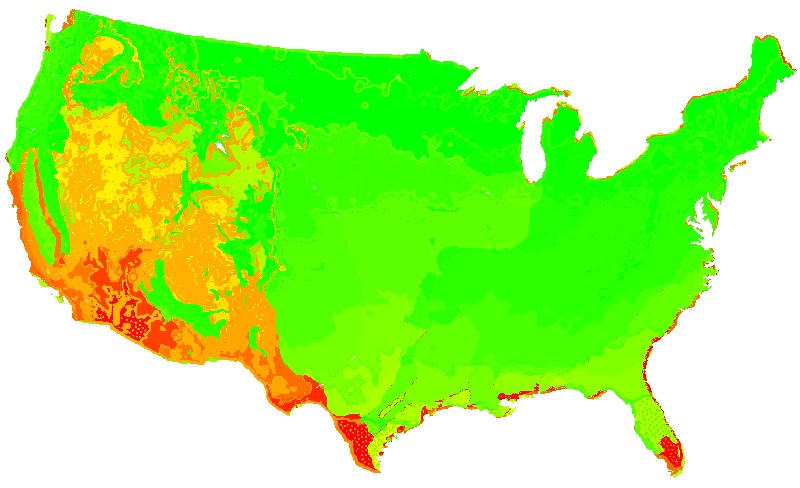
Current wildfire map

Inspiration
Living in California, we constantly suffer from annual fires as climate change continues to warm the globe. Unfortunately, it seems that many do not understand the fate of our environment if we fail to take preventative action. The first step to stopping forest fires is to spread awareness so that everybody can join our cause.
What it does
Fire Predictor shows users how the risk of fires will continue to increase in the future. Users can input any year, to generate a color-coded map that shows how vulnerable various regions of the United States will be to fires.
How we built it
For the model itself, Fire Predictor uses Python backend to efficiently compute data and generate images. By analyzing data sets for vegetation, temperature, and humidity, our model can accurately generate a risk index for every region in the United States. With Python's Pillow library, we were able to take images as input, and output a color-coded map that demonstrates the results.
Challenges we ran into
Despite having plenty of back-end experience, we quickly realized that our team lacked experience in front-end. After creating our fire predicting model, we quickly began to accommodate ourselves with HTML, and the Python Flask framework in order to make a website for our creation. Additionally, one of the challenges of a model that attempts to predict the future is finding equations that give realistic results. To solve this issue, we had to scour the web for hours, looking for reputable research papers to create a cumulative model that accurately predicts fire risk.
Accomplishments that we're proud of
One of our greatest accomplishments was creating an accurate model that used image I/O to generate maps of fire risk. Another accomplishment was creating an aesthetic website that allows users to see fire risk any number of years into the future. By scouring public databases of forest fire data for countless hours, and learning how to use Flask/HTML, we were ultimately successful in our endeavors.
What we learned
We learned a lot by working on our project fire predictor. As stated earlier we barely had any experience with front-end development so we learned how to make a website from scratch. Additionally, we learned the intricacies of cloud platforms such as google cloud and python anywhere.
What's next for Fire Predictor
We would like to expand the fire predictor to include global data so we could expand our services to the entire globe. We will also include more variables such as wind speed to increase the accuracy of our model.


Log in or sign up for Devpost to join the conversation.