-
-
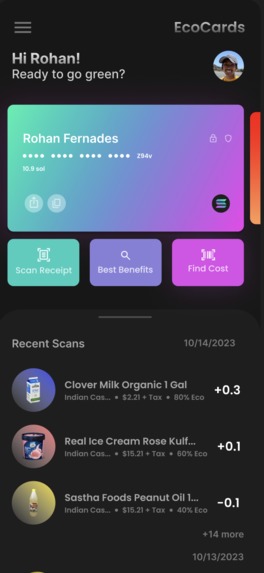
Homepage of our app
-
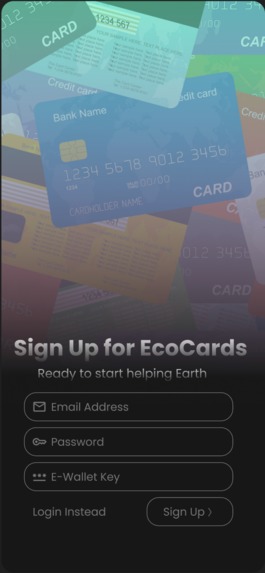
Sign up page
-
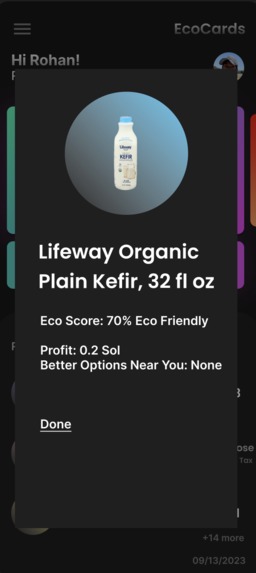
Our eco friendly score calculation


Inspiration
Our inspiration for EcoCard was the lack of incentives for people to make eco-friendly choices. Currently, due to the cost of many eco-friendly products, people refrain from making choices that are eco-friendly in order to save money. Our app helps to solve this issue by leveling the playing field by adding incentives for customers to purchase eco-friendly items rather than non-eco-friendly items
What it does
EcoCard employs advanced receipt-scanning technology to assess the eco-friendliness of recent purchases, utilizing the OpenAI API. Following a rigorous evaluation, we generate an eco-friendliness score for these items and subsequently credit the user's account with the corresponding score as a measure of their sustainable shopping choices.
How we built it
EcoCard was built using the most cutting-edge tech stack, which includes Next.js for the UI and UX, Firebase for user authentication, Express.js for the node server, and Python to handle all the Solana logic.
Challenges we ran into
Our JavaScript Solana logic did not work initially, so we had to switch over the logic code to Python so that our Solana logic actually worked.
Accomplishments that we're proud of
This is one of our first applications where our team integrated web3 into the project. We are also proud of the fact that we are using our ability to develop web apps to promote a sustainable future for our community
What we learned
We learned that we should manage our time more wisely. We finished our project right on time but could have spent our time more efficiently and coordinated with our team members on when we were going to be away.
We also learned about methods to communicate better and to enrich our team’s collaboration and spirit.
What's next for EcoCard
We have a lot of further improvements planned for EcoCard. Some of these improvements include improving the receipt scanner code, being able to provide extensive reasoning into why products are either eco-friendly or non-eco-friendly, and integrating our app with e-commerce platforms that use SOL as their trading token. Finally, we want to publish our app in emerging markets where people’s knowledge of eco-friendly products is limited.
On a final note, a huge thank you to all the judges and the organizers of ChargerHacks for providing us with an opportunity to build this application and help promote a sustainable future for all.
Also another huge thank you to Pradham for being the brains behind organizing this hackathon and providing these awesome prizes
Built With
- express.js
- javascript
- next.js
- node.js
- opencv
- python
- react
- solana


Log in or sign up for Devpost to join the conversation.