-
-
-

our taskbar icon
-


inspiration
the apparel industry uses 20 trillion gallons of water every year [https://www.ellenmacarthurfoundation.org/a-new-textiles-economy], more than any sector outside of agriculture. for reference, the entire human population drinks less than half a trillion gallons of water per year. apparel is also responsible for over 10% [https://unfccc.int/news/un-helps-fashion-industry-shift-to-low-carbon] of annual global carbon emissions, more than international flights and shipping combined. we built dripped to provide a market incentive for more sustainable apparel production practices.
dripped
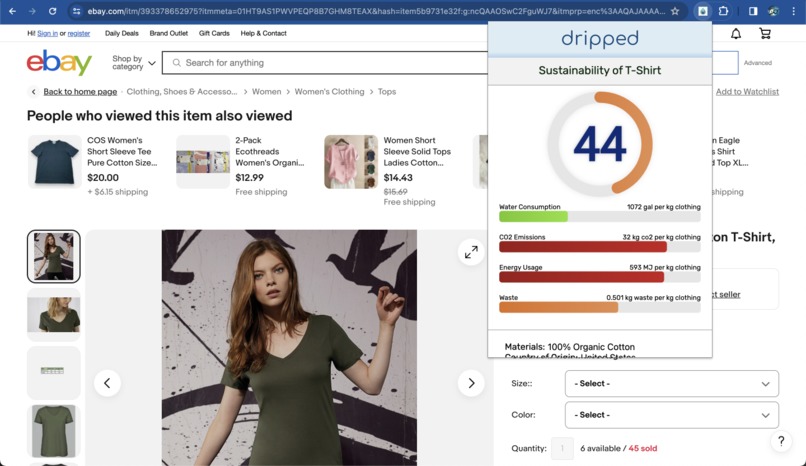
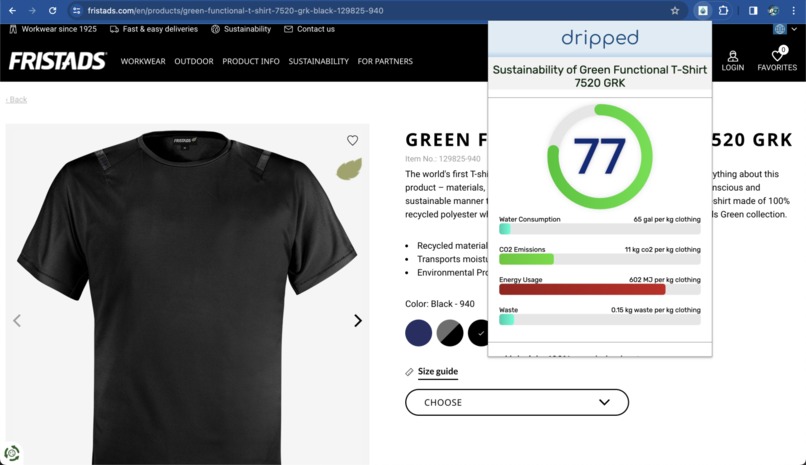
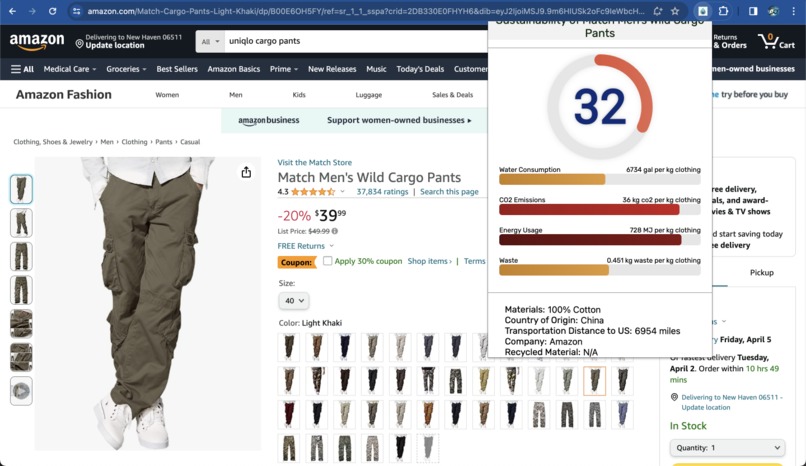
dripped is a web extension that provides consumers with the estimated environmental impact of any apparel item with a single click. our comprehensive estimates cover the entire apparel lifecycle, from raw material production to supply chain transportation to daily consumer usage to disposal. we provide consumers with the information needed to get dripped sustainably, encouraging companies to adopt more eco-friendly production practices to satisfy increased demand.
how it works
when a consumer navigates to an apparel listing on any website and presses the extension icon in their taskbar, dripped instantly scrapes the page and prompts gpt-3.5-turbo to extract relevant information about the item (e.g. materials, recyclability, production location, brand information). we use this information as features in our lightweight neural net (trained from the ground up on a custom-built dataset), which returns estimated values for total water usage, carbon production, energy usage, and waste produced.
challenges
our core challenge was constructing a pipeline to automatically collect data from online shopping websites and translating into accurate estimated metrics of the product's sustainability. we realized that training our own neural network would work well for the estimation task because we could supplement our model with several different inputs. training the neural network ourselves become one of our biggest challenges. since the comprehensive life cycle effects of clothing are hard to calculate and not publicly available, we decided to construct our own dataset. we spent a lot of our time finding reliable figures by looking through documents like company memos and external auditing documents, then used our knowledge of machine learning training to tune the model. we were able to achieve a final loss of 0.16. ultimately, leveraging machine learning in our own model and the LLM has helped us make our algorithm very robust even in various shopping websites.
what's next for dripped
next, we aim to incorporate a recommendation system to propose sustainable alternatives to non eco-friendly apparel items to make sustainable purchasing more streamlined.

Log in or sign up for Devpost to join the conversation.