-
-
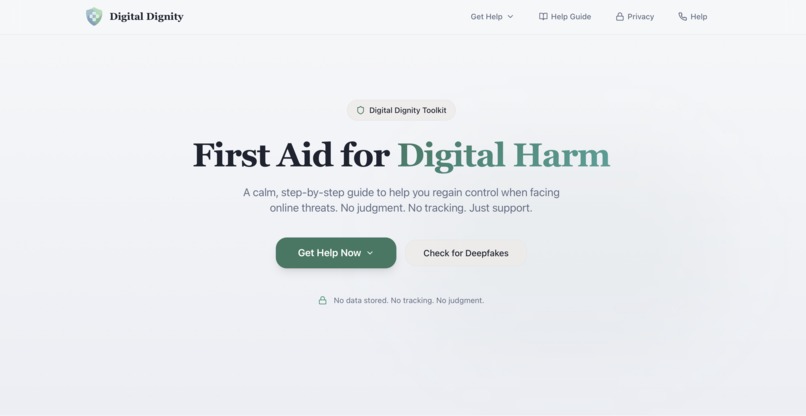
main screen landing

🧠 Inspiration
Digital harm often happens suddenly — harassment, blackmail, image abuse, deepfakes, or threats.
In those moments, users don’t need articles, explanations, or policies. They need clear actions, privacy, and immediate guidance.
Most existing solutions:
- overwhelm users with information
- require sign-ups or data sharing
- assume the user already knows what to do
- fail to account for fear, panic, or time pressure
Digital Dignity Toolkit was built to address these gaps with a focused, practical approach centered on dignity, safety, and privacy.
🛡️ What It Does
Digital Dignity Toolkit is a privacy-first, browser-only digital first aid system.
The project provides:
- step-by-step guidance for the first critical minutes after online harm
- clear instructions to preserve evidence correctly
- scenario-based response paths so users don’t have to explain everything
- direct access to trusted human support organizations
- optional AI-assisted guidance for understanding next steps
No accounts. No tracking. No data storage.
All interactions remain local to the user’s browser.
🛠️ How We Built It
The project was built with privacy as a technical constraint, not a feature.
Key design decisions:
- Entirely client-side architecture
- No cookies, analytics, or local/session storage
- No server-side uploads, including images
- Browser-only processing for deepfake risk checks
- Optional AI integration used strictly for guidance, not logging or retention
The system is modular and scenario-driven, allowing users to quickly reach relevant guidance without unnecessary navigation.
⚠️ Challenges We Ran Into
- Designing flows for users under stress and time pressure
- Keeping instructions short, actionable, and non-alarming
- Providing under-18 guidance without overcomplication
- Integrating AI support while maintaining zero data retention
- Ensuring privacy guarantees are enforced by architecture
Each decision required balancing usability, responsibility, and technical limitations.
🏆 Accomplishments
- A zero-data, zero-tracking implementation verified by design
- A structured first 10 minutes response flow for crisis situations
- Dedicated under-18 protection guidance integrated into the toolkit
- Fully client-side deepfake risk analysis
- A production-ready prototype suitable for real-world use
The result is a functional toolkit, not a conceptual demo.
📚 What We Learned
- Privacy-first systems must be designed from the start
- Simpler interfaces perform better during high-stress situations
- Clear instructions prevent common user mistakes during crises
- AI is most effective when used as assistive support, not authority
- Product decisions matter as much as technical implementation
🚀 What’s Next for Digital Dignity
- Pre-incident digital safety planning tools
- Account security and preparation guides
- Practice workflows for evidence capture and storage
- Expanded region-specific support resources
- Continued refinement of privacy-preserving analysis tools
Digital Dignity Toolkit will continue to evolve as a practical, user-first response system for online harm.
Built With
- css
- geminiapi
- html
- react
- tailwind
- typescript
Log in or sign up for Devpost to join the conversation.