-
-
DiagAI Logo
-
DiagAI


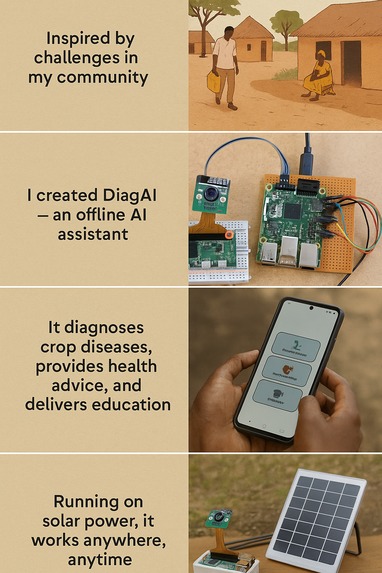
## Inspiration Growing up in Nigeria, I’ve seen firsthand how limited access to essential services—especially healthcare, education, and agriculture—can trap entire communities in cycles of hardship. In many rural areas, a mother guesses her child’s illness without a doctor, a farmer watches crops die without knowing the cause, and students lack the tools to learn. These stories aren’t distant—they are my reality. They inspired me to build something that could work without internet, without power, and still change lives. DiagAI was born out of survival, necessity, and the deep belief that every African life deserves smart, accessible solutions.
##What It Does DiagAI is an AI-powered offline assistant that delivers essential services in areas with little or no connectivity. It: Helps farmers diagnose crop diseases using a camera and ML models. Assists individuals in basic health triage through offline voice interaction. Offers localized educational content in English and Hausa. Collects data and syncs it to the cloud only when internet becomes available. Works on low-cost Raspberry Pi hardware powered by solar energy. It’s not just software—it’s a lifeline in offline environments.
##How We Built It We built DiagAI with three core principles: lightweight, low-power, and language-accessible. Used TensorFlow Lite, YOLOv5 Nano, and Vosk for embedded AI on Raspberry Pi. Created a voice-driven assistant that understands Hausa and English, designed for non-literate users. Built IoT modules with environmental sensors for farming insights. Designed a modular edge system with solar-powered Pi boards that run 16–18 hours on a single charge. Integrated offline-first architecture using SQLite and data caching. Everything was built from scratch, optimized to function in real-world Nigerian conditions.
##Challenges We Ran Into Hardware Access: Procuring Raspberry Pis and sensors in Nigeria was both expensive and slow. Energy Constraints: Frequent power outages forced reliance on solar power—so we reengineered our hardware for ultra-efficiency. Voice Recognition: Training an AI to understand local dialects wasn’t easy. We worked with real people, recorded voices, and iterated. Mental Fatigue: As an individual dealing with health issues, there were days progress stalled—but quitting was never an option. Connectivity: Pushing updates and libraries with minimal internet was a nightmare. I had to batch downloads using mobile data.
##Accomplishments That We're Proud Of Built a fully functional offline AI system running on solar power. Achieved over 85% accuracy in voice recognition and 88% for image classification under local conditions. Created a platform that a farmer, teacher, or mother can use without literacy or tech skills. Survived every setback and made it to the final round with zero shortcuts, driven by purpose. Turned an idea from a remote village into a scalable, working solution.
##What We Learned That constraints breed innovation. When you can’t rely on the internet or power, you dig deeper into creativity. That technology is only meaningful if it’s accessible. That with resilience, grit, and a strong reason why, even one person can build something that matters. That Africa doesn’t need hand-me-down tech—it needs context-aware innovation.
##What's Next for DiagAI This is just the beginning. Our next steps include: Scaling across rural regions in Nigeria with NGO and government partnerships. Expanding language support to include Yoruba, Igbo, and Fulfulde. Adding maternal health modules, mental health screening, and financial literacy content. Creating a community version so local developers can contribute and adapt DiagAI to their own regions. Open-sourcing parts of the stack to invite more grassroots innovation in Africa. If innovation is about solving real problems, then DiagAI is proof that Africa can build its own future—one voice, one diagnosis, one village at a time.
Built With
- crontab
- flask
- javascript
- mobilenet
- node-red
- node-red)
- opencv
- shell/bash
- tensorflow
- yolov5

Log in or sign up for Devpost to join the conversation.