-
-
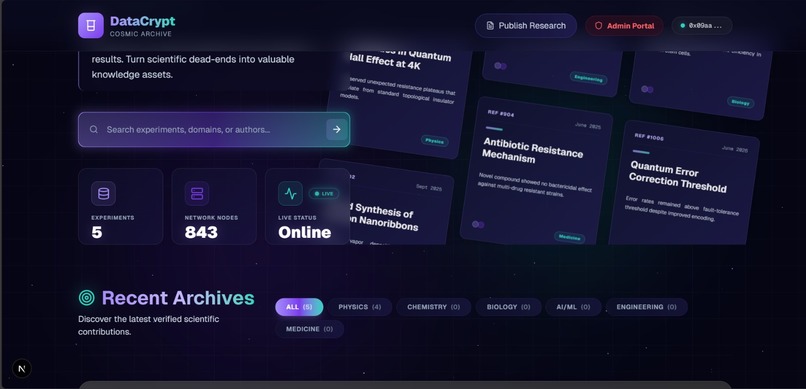
Explore DataCrypt: The Cosmic Archive turning scientific dead-ends into assets. Browse verified experiments and live network stats.
-
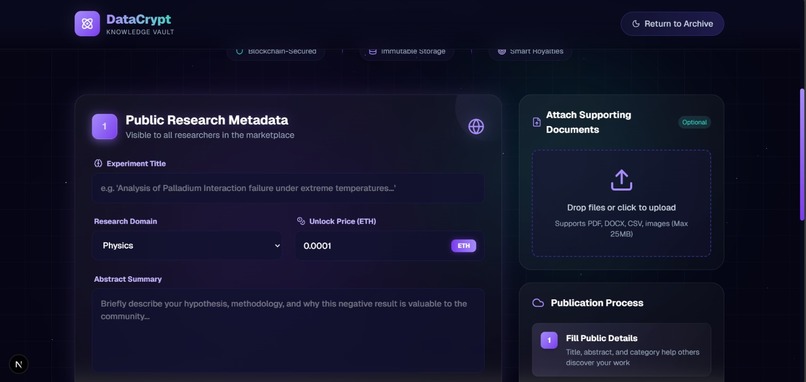
Set the Stage: Input public metadata, select your domain, and set an ETH unlock price for your research.
-
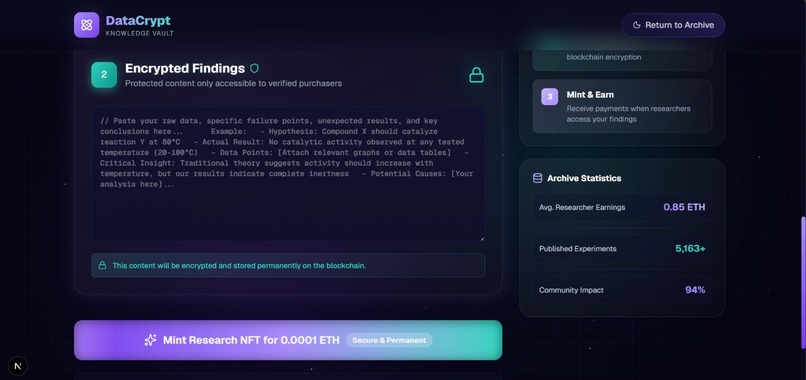
Mint & Earn: Encrypt raw findings, mint a permanent Research NFT, and earn ETH whenever peers access your data.
-
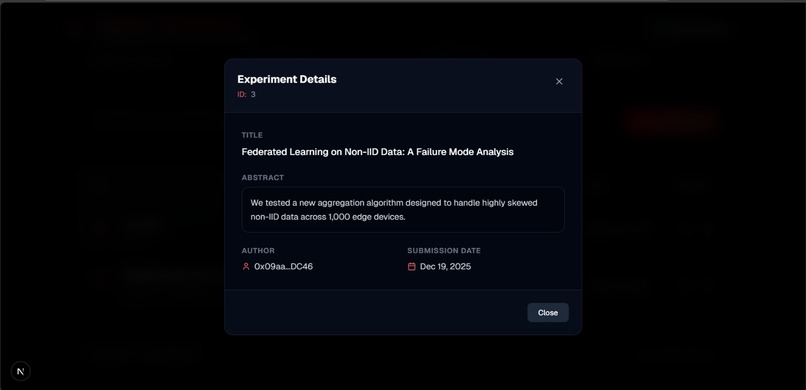
Verify Details: Inspect abstracts, author IDs, and timestamps to validate experiments before blockchain storage.
-
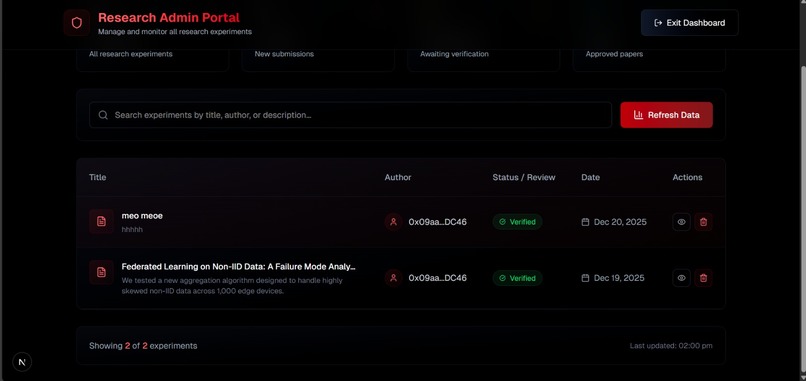
Admin Control: Monitor submissions, verify status, and manage the research database from a central dashboard.


Inspiration
The inspiration for FailVault (DataCrypt) stems from a critical inefficiency in global research: Positive Publication Bias. Millions of hours and billions of dollars are wasted every year because researchers unknowingly repeat experiments that have already failed elsewhere. We wanted to create a platform where "failure" isn't a dead end, but a valuable asset that can be secured, shared, and monetized to accelerate scientific discovery.
What it does
FailVault is a Decentralized Science (DeSci) marketplace that allows researchers to mint their negative results as IP-NFTs.
- Monetize Failure: Researchers set an unlock price in ETH for their findings.
- Secure IP: Using a hybrid architecture, public metadata is searchable, while critical findings and raw datasets are encrypted and only accessible to buyers.
- Immutable Proof: Every experiment is timestamped on the Polygon Amoy Testnet, providing permanent proof of discovery and ownership.
How we built it
We engineered a full-stack dApp utilizing:
- Frontend: A high-performance Next.js 14 application styled with a "Cosmic Deep Blue" Tailwind CSS theme and Lucide React icons.
- Blockchain: Solidity smart contracts deployed on the Polygon Amoy Testnet to handle NFT minting and ownership logic.
- Backend & Storage: Supabase for robust metadata management and indexing.
- Web3 Integration: Ethers.js for handling MetaMask interactions and automated network-guard switching.
Challenges we ran into
- The Hydration Nightmare: We faced critical Hydration Errors when building our dynamic starfield background. Because
Math.random()generated different values on the server than on the client, the UI tree mismatched. We solved this by moving all randomized coordinate generation into auseEffecthook to ensure stable client-side rendering. - The RPC Error Wall: We struggled with constant
Internal JSON-RPCerrors during testing. We discovered this was due to Cross-Chain UX friction, as MetaMask often defaulted to Ethereum Mainnet while our contract lived on Amoy. We engineered a programmatic "network guard" that intercepts transactions and forces the correct Polygon Amoy context automatically.
Accomplishments that we're proud of
- Successfully creating a seamless bridge between traditional database storage (Supabase) and immutable blockchain storage.
- Achieving a premium "Cosmic" aesthetic that makes scientific data entry feel futuristic and engaging.
- Building a programmatic network-switching logic that significantly lowers the barrier for non-crypto-native researchers to use the platform.
What we learned
We gained deep insights into the DeSci (Decentralized Science) movement and the complexities of handling sensitive data on-chain. We learned how to manage complex React lifecycles to prevent hydration mismatches and how to optimize smart contract gas limits for high-data transactions on Polygon.
What's next for DataCrypt
- On-Chain Encryption: Implementing fully decentralized encryption using Lit Protocol.
- DAO Governance: Allowing the community to verify the quality of research through a peer-review staking system.
- Cross-Chain Expansion: Deploying to other EVM-compatible chains to broaden the research marketplace.
Built With
- amoy
- blockchain
- css
- ether.js
- hardhat
- ipfs
- javascript
- lucide
- metamask
- next.js
- polygon
- react
- solidity
- supabase
- tailwind
- typescript
Log in or sign up for Devpost to join the conversation.