-
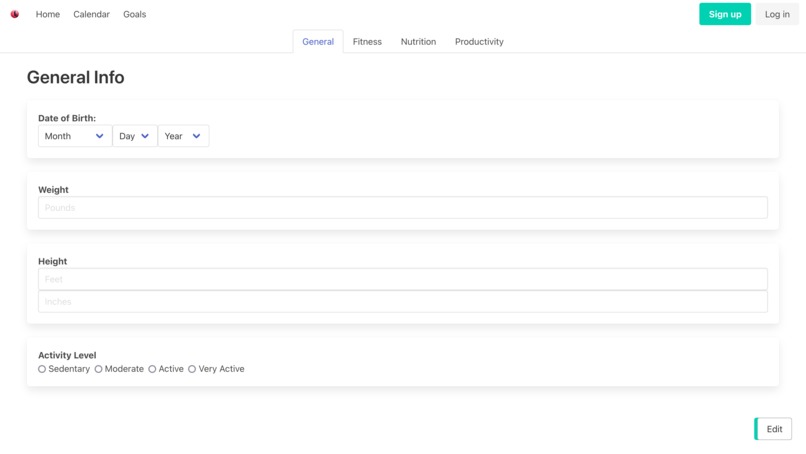
You can update goals here in case anything changes
-
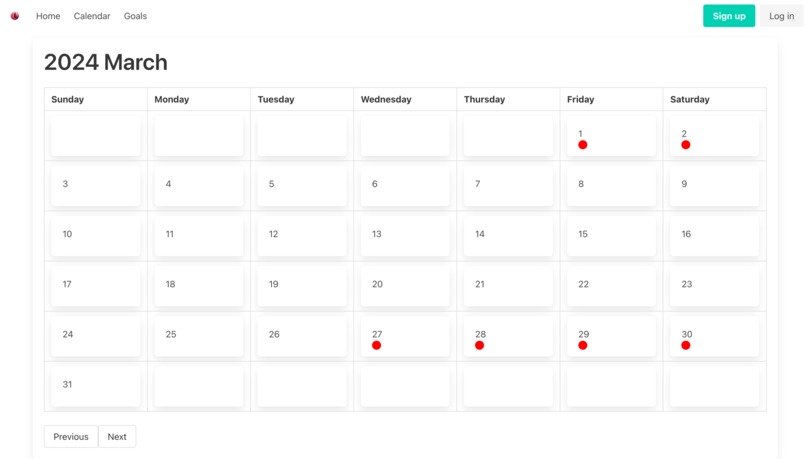
This is the period tracking calendar.
-
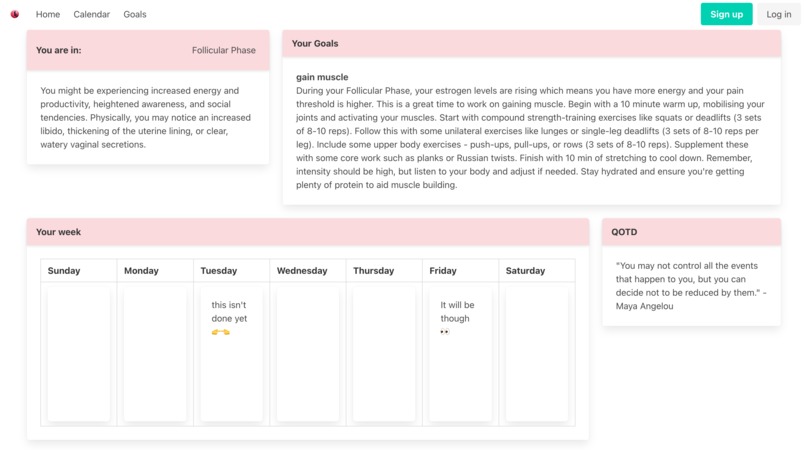
Our home page has suggestions and reccomendations based on the phase of your mentrual cycle you are on


Inspiration
The inspiration behind Dalendar began when we noticed our productivity levels fluctuated greatly throughout each month which was inconvenient when it came to work, school, fitness, and other factors in our lives. We vaguely noticed that there was a trend and after doing some research, we learned that while men are on a 24-hour hormonal cycle, women typically operate on a 28-day cycle with four distinct phases: menstrual, follicular, ovulation, luteal. After learning that these energy-level shifts were natural and not reasons to blame on laziness or weakness, we found a passion to want to spread awareness as well as offer a tool for women to track and plan around these fluctuations and make the most out of every day.
The name "Dalendar" was inspired by a play on two Korean words: dal and ddal which mean "moon" and "daughter", respectively. We found this name to be fitting as we are both daughters of Korean descent and the moon operates on a 29.5 day cycle, approximately the same as a typical hormonal cycle for women.
What it does
Dalendar is a useful tool to help women become the people they have always strived to become. It acts as a calendar, to-do list, period tracker, fitness planner, nutrition tracker, mood indicator, and motivational assistant all in one. While utilizing your cycle to track energy levels and offer suggestions, Dalendar can be a powerful tool to understand more about your body as well as become who you want to be.
How we built it
We used an Angular frontend, paired with the Bulma CSS styling framework. We connected the our Angular application to a nodejs backend, where we created and sent queries to the OpenAI API.
Challenges we ran into
We wanted to integrate an external calendar from npm, however this resulted in many unforeseen issues. We ultimately decided to create our own calendar instead to reduce more unnecessary time wasted.
We also ran into many problems with API calls with OpenAI and axios which caused us to refactor a huge part of our code and delayed our progress significantly.
Accomplishments that we're proud of
We both had prior commitments which delayed our start time by six hours, however we were still able to complete a majority of the planned functionality. Some particular achievements that we would like to highlight are:
- The Custom Calendar Component: this took quite a bit of effort, but we eventually got to the point where we felt comfortable with it!
- Overcoming our struggles with promises and observables in Angular! We spent an ungodly amount of time trying to figure out how to get this to work, and it definitely paid off!
What we learned
We learned a lot of structure-related necessities when it came to angular, such as how modules must be used for certain implementations. We also learned how to use Bulma to structure frontend.
What's next for Dalendar
We would love to incorporate more backend functionality such as database implementation for persisting users and integrate more APIs to provide more features for app users. We are also interested in migrating to a mobile application for more convenient usage. We would like to proceed with a lot of the functionality we were unable to implement within the deadline such as a to-do list and menstrual symptom tracker.
We would also like to account for those who have gone through/are going through menopause as well as those who have lost their period due to activity level or other factors.
Built With
- angular.js
- bulma
- css
- html
- javascript
- node.js
- openai
- typescript


Log in or sign up for Devpost to join the conversation.