-
-
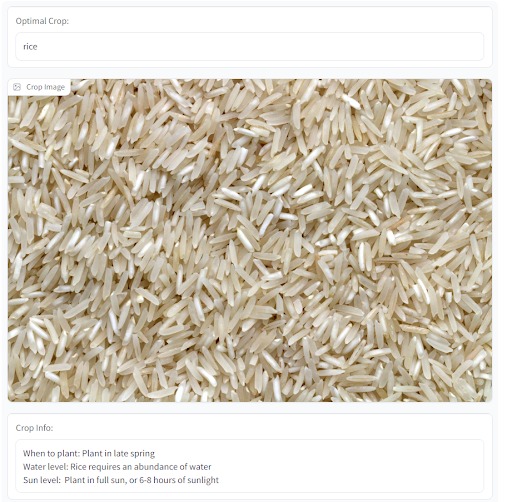
Predicted Crop
-
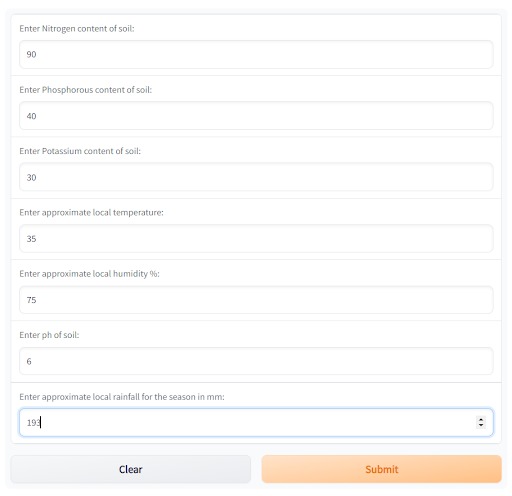
Input Parameters


Inspiration
According to the World Bank, India is currently facing major issues in agriculture, including crop productivity which unfortunately leads to food insecurity. If there was a way to make the farming process more efficient, farmers would be able to increase yields, increase profits, and feed more people… Team Technophobia has created a Crop Prediction tool that solves this problem.
What it does
Based upon data collected by the Indian Chamber of Food and Ag, our tool implements a machine learning model to accurately predict the optimal crop for the inputted conditions. It also provides growing recommendations for given soil and environmental variables.
How we built it
To construct the machine learning model for our project, we used the XGBoost software library for Python. XGBoost is an open-source implementation of the gradient boosted trees algorithm. It has been engineered for optimal performance and it is known to perform well for structured, tabular data - one of the key reasons why we selected it. The model generated for our project reached an accuracy of .9964 in prediction when using a 75-25 train-test split of the data. The project utilizes Gradio (https://gradio.app/) to provide an interactive interface for users to input environmental conditions and read the output.
The dataset is taken from Kaggle and provides a label for the optimal crop based on the Nitrogen, Phosphorous, Potassium, temperature, humidity, pH, and rainfall levels that are observed in the environment. There are a total of 22 possible crop labels in the dataset.
Challenges we ran into
We had to learn Gradio, which at times was a challenge. It was hard to layout the page in the right format. It was also difficult getting images and descriptions to dynamically render.
Accomplishments that we're proud of
We are proud that we were able to dynamically update components and have an accurate model. We are also proud to have our first fully functional HackNC submission as a team!
What we learned
We learned new tools and how to work together as a team!
What's next for Crop Solver
What's next is to find a larger crop dataset so the application can be more widely used! We would also like to integrate several other features that provide more relevant insight into land use for farmers.
Built With
- gradio
- python
- xgboost
Log in or sign up for Devpost to join the conversation.