-
-
Logo
-
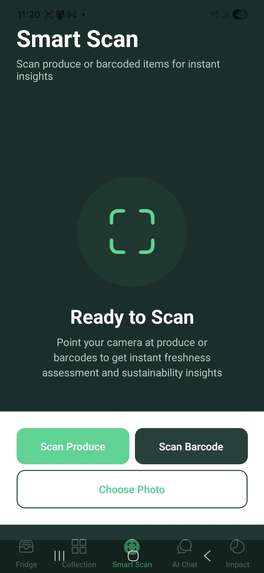
Ready to Scan
-

apple
-
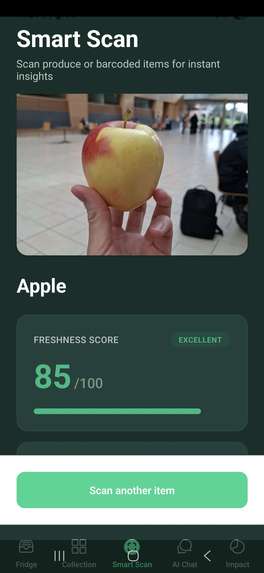
apple freshness
-
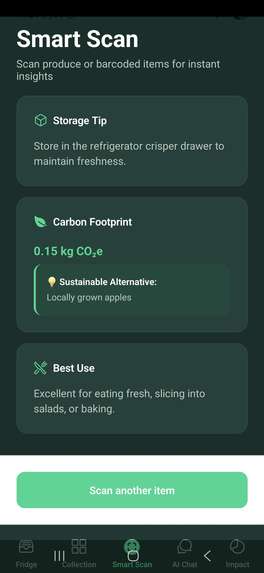
carbon footprint
-
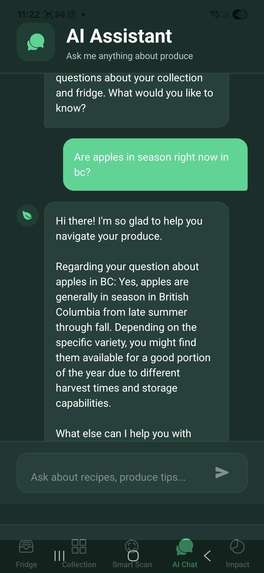
ai assistant


Inspiration
We were shocked to learn that nearly one-third of all food produced globally is wasted, contributing to a massive 10% of total greenhouse gas emissions. Much of this waste happens in our own kitchens because we rely on conservative "best-by" dates or guesswork. We wanted to build a tool that gives users "superhuman" vision to see the actual state of their food, helping them save money and the planet simultaneously.
What it does
CrispIt is an AI-powered sustainability platform that helps households eliminate food waste through intelligent tracking and analysis.
- True Expiration Scan: Using computer vision, the app analyzes the physical condition of produce and groceries to provide a scientifically grounded "True Expiration" date rather than a static label date.
- Carbon Dashboard: It visualizes the environmental impact of your consumption, tracking saved $CO_2e$ emissions and diverted methane.
- AI Sustainability Assistant: A built-in expert assistant that helps users with sustainability questions, provides storage tips, and suggests creative ways to use ingredients before they spoil.
- Smart Inventory: Automatically logs scanned items into a pantry for real-time tracking of your household's waste footprint.
How we built it
- AI & Vision: The Gemini API handles multimodal analysis of food images and powers the core logic of our Sustainability Assistant for expiration forecasting and user Q&A.
- Data Persistence: We implemented a local persistence layer to ensure ultra-fast data retrieval and a seamless user experience without the latency of external database calls.
- Frontend: Built with a focus on clean, minimalist UX to make complex environmental data easy to digest at a glance.
Challenges we ran into
One of our primary obstacles was LLM orchestration and rate limiting. We initially struggled with hitting token limits while processing high-resolution food images for our "True Expiration" logic. We had to optimize our prompt engineering—eventually landing on Gemini 2.5 Flash for its superior speed and efficiency—to ensure the app remained responsive.
We also faced a critical architectural decision regarding Data Storage. We initially considered a cloud-based database but ultimately pivoted to Local Persistence. This allowed us to bypass cloud latency and configuration hurdles, ensuring that our inventory stayed synchronized and snappy during live demos.
Finally, we navigated massive Git merge conflicts. Integrating the vision backend with the dashboard frontend while working on parallel branches led to several "code freezes" where we had to manually reconcile disparate histories to keep the project moving.
Accomplishments that we're proud of
We are incredibly proud of our Carbon Dashboard accuracy. Translating a specific weight of wasted spinach into precise methane and $CO_2$ equivalents was a technical challenge that adds real weight to the project's mission.
What we learned
This project taught us the power of "Hybrid Intelligence." While databases like Open Food Facts provide great metadata, they lack real-time "state" data. We learned how to combine static database records with live AI vision to create a tool that is much more useful than the sum of its parts. We also deepened our understanding of the circular economy and the technical math behind carbon tracking.
What's next for CrispIt
- Recipe Integration: Connecting the AI Assistant to recipe APIs to automatically suggest meals based on items that are 24 hours away from expiring.
- Voice-Enabled Assistant: Integrating a text-to-speech engine like ElevenLabs to make the assistant hands-free for busy kitchens. This could also be used while grocery shopping if you don't want to scan everything and just look yourself.
Built With
- claude
- expo.io
- express.js
- gemini
- javascript
- jsx
- node.js
- openrouter
- react-native
- typescript

Log in or sign up for Devpost to join the conversation.