-
-
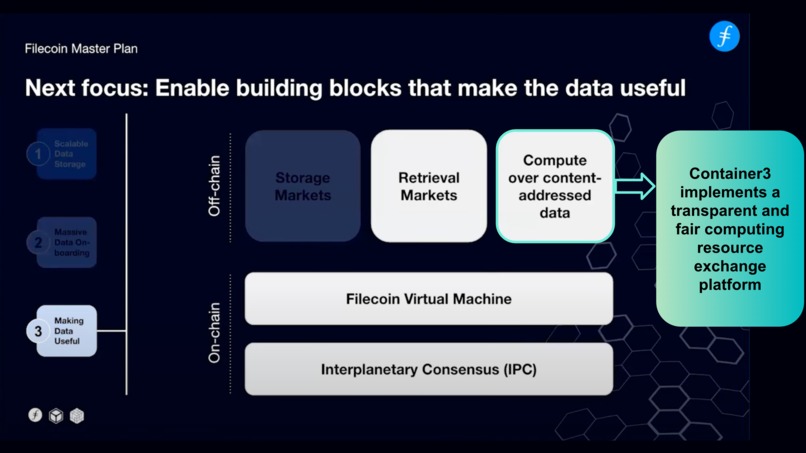
Positioning
-
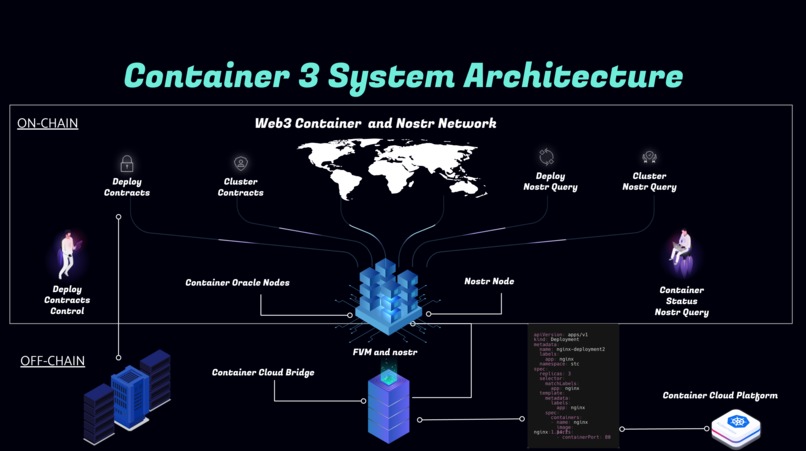
Architecture


Inspiration
There are many centralization and monopoly problems in the current Internet, especially in the field of cloud computing. At present, most cloud computing services are monopolized by a few large companies. These companies have a large amount of user data and computing resources, posing a great threat to user privacy and data security. At the same time, due to the monopoly of these companies, it is difficult for many small users and SMEs to accept the high cost of cloud computing, which has greatly restricted their business development and innovation.
Container3 provides a brand-new cloud computing service model through blockchain technology, smart contracts, and decentralized storage technologies, realizing the decentralization, autonomy, and distributed management of resources and rights, and avoiding data centralization Risks of institutional abuse and monopoly, while also enabling small users and SMEs to afford cloud computing services, thus expanding the market space and potential. In short, Container3 aims to solve the problems existing in existing cloud computing services and promote the development of the Internet in a direction of decentralization, autonomy and fairness.
What it does
Container3 can realize many functions that cannot be realized by traditional cloud computing, mainly including the following aspects:
- Decentralized storage and management: Through decentralized resource storage and management, Container3 can better protect data privacy and security, and avoid risks caused by data abuse and monopoly by centralized institutions.
- Decentralized application and development environment: Container3 provides a distributed application development environment, users can more easily develop and deploy their own decentralized applications, and achieve more autonomous and flexible application management.
- Smart contracts and oracle mechanisms: Container3 supports smart contracts and oracle mechanisms, which can automate and programmatically execute many tasks, thereby improving computing efficiency and reducing costs.
- DAO and resource sharing: Container3 supports the DAO (Decentralized Autonomous Organization) mechanism, which can achieve more fair, transparent and efficient resource sharing and allocation.
- Cryptocurrency and payment: Container3 supports cryptocurrency and smart contract payment mechanisms, allowing users to make payments and transactions more quickly, securely and transparently.
Container3 can realize more decentralized, autonomous, secure and transparent computing and application scenarios, and provide users with more flexible, efficient and innovative services.
How we built it
The construction of the Container3 resource exchange platform is mainly based on the following aspects:
Based on FVM
Design and implement based on FVM, use decentralized smart contracts, oracle control mechanisms and distributed storage to manage resources and rights, ensure data privacy and security, including using IPFS off-chain storage and chain on storage.
Smart contract
Use smart contract technology to automate and programmatically implement control instructions, reducing the cost and risk of manual intervention.
https://github.com/stc-community/container3/tree/main/contract
Oracle and credible proof
Integrate the oracle control contract, including service orchestration, security and authority control, and provide off-chain TLS verifiable communication proof.
DAO
The platform supports the DAO mechanism through the contract, which can realize autonomous and autonomous distributed management.
Encrypted currency and payment
The platform supports encrypted currency and smart contract payment mechanism, users can pay and trade more quickly, securely and transparently, and can use encrypted currency such as FIL to realize.
Challenges we ran into
- User needs: It is necessary to meet the needs of users for privacy, security, decentralization, autonomy, etc., make accurate judgments on user needs, and optimize and improve them.
- Ecological construction: It is necessary to establish a complete ecological system, including users, developers, applications and ecological partners, etc., which needs to attract sufficient manpower, material resources and capital investment.
- Security: Sensitive data and assets are involved, and high-strength security protection measures are required. At the same time, security risks such as hacker attacks and technical vulnerabilities must be faced.
Accomplishments that we're proud of
The Container3 platform has achieved a number of achievements, including the following:
- Anti-monopoly: The platform realizes decentralized computing and storage, thereby avoiding the monopoly of traditional cloud computing platforms, and the openness and accessibility have increased significantly.
- Data privacy and security: It can ensure the privacy and security of data, and the data is stored on a distributed network, which can avoid the risk of privacy leakage to third parties.
- DAO: Self-government and self-management are realized through the DAO mechanism, which can achieve more fair and flexible distributed governance, thereby achieving more equitable resource allocation and ecological adjustment.
What we learned
- Platform expansion: The platform needs to continuously improve its scalability to support more users and applications.
- Security: Improve the security of oracle control and enhance the proof of offline traffic communication.
- Ecological construction: establish a more complete ecosystem, promote the interaction and communication between developers and users, and add more applications and services.
What's next for Container3
- Optimize smart contracts to reduce gas costs.
- Incentivize node suppliers to provide more decentralized network nodes.
- Establish a user community to promote interaction and communication between developers and users.
- The open source community that built the program returns control of the program to the open source community.


Log in or sign up for Devpost to join the conversation.