-
-
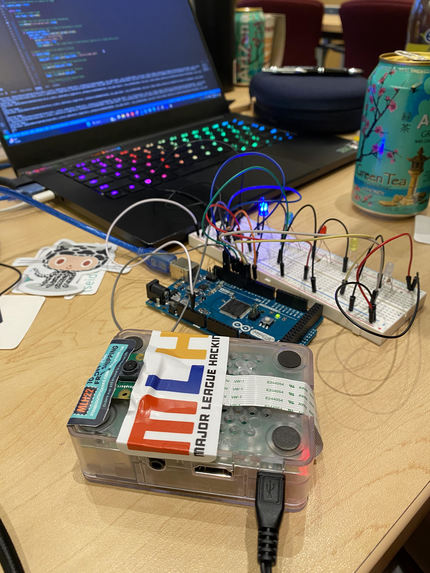
Rasberry PI, PI camera, cv enabled camera opened, and LED circuit
-
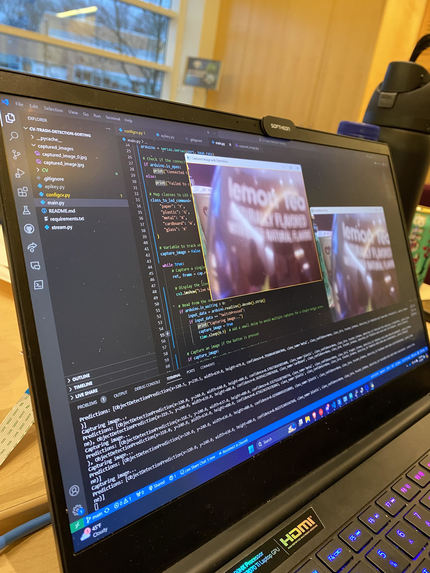
VSC, cv enabled camera detecting plastic bottle, Arduino IDE code
-
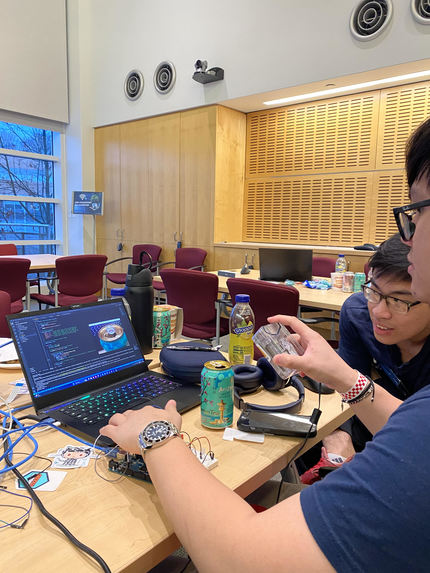
Collaborative testing
-
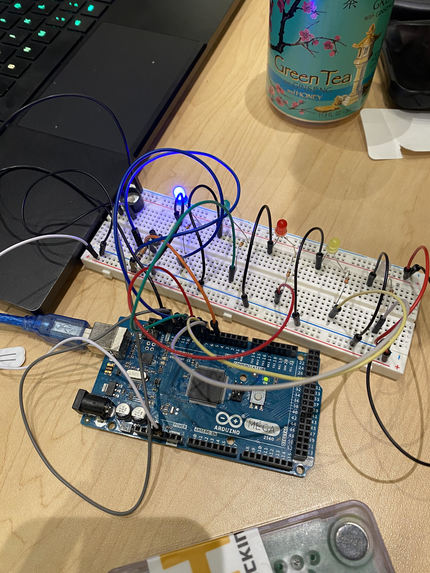
Arduino connected to LED circuit


Inspiration
If you've ever walked the streets of a busy city or college campus, then you would probably agree that most people can relate to seeing and using large metal trash bins that collect waste and recyclables around every street corner. Unfortunately, we think too many people would also raise their hand if asked if they're super careful with which bin they dispose of their trash every time they want to throw something out. An individual rushing to catch a train for work could easily toss their empty coffee cup into the plastics bin. Whether it's food scraps or plastic bottles, many of us could be guilty of similar improper disposal of waste and recyclables. But that's okay, because we believe there's a better solution: to utilize the capabilities of computer vision to assist in recycling.
What it does
Our system utilizes a computer vision enabled camera to detect recyclable objects thrown into a bin and uses the data to sort them into smaller storage compartments internally. Our subscale system uses LEDs to indicate successful detection and sorting of the objects. There are four primary categories for recyclables our system is able to detect and sort: metal (Blue LED), plastic (Green LED), glass (Red LED), paper (Yellow LED), and cardboard (White LED). When an object comes into view of the camera, the system will identify the object and the LED correlated with the respective type of recyclable will light up.
How we built it
We built our system using a combination of hardware and software techniques. For our LED sorting component, we created an Arduino-based LED circuit utilizing a buzzer for better user feedback and a pushbutton to capture still images of the object for the camera. The camera itself runs off our raspberry pi 3. In addition to this, we have our computer vision enabled camera system that runs off a model through an API. Using the model, we can identify various object types and write a program that will change the LED colors depending on what type of object the camera sees.
Challenges we ran into
We ran into numerous challenges with configuration, programming, and implementation. In particular, we found it difficult to understand how to train our model initially. We struggled to find resources the help get a trained model that would reliably identify the types of recyclables we wanted to sort in our system. Towards the later phase of our project progression, we also found it hard to get the Arduino to communicate and respond to our python scripts. It required line by line debugging and troubleshooting to understand how to resolve each error.
Accomplishments that we're proud of
We're incredibly proud of being able to create a substantive project that explores and utilizes unfamiliar software methods and concepts, specifically computer vision. Our team had no computer vision experience prior to this project so we're really happy with how much we were able to learn and create through strenuous research and testing. We're also proud of being able to overcome difficult debugging challenges both with configuring our Arduino circuit and trying to run the model using the raspberry pi camera.
What we learned
After several dozen hours of coding and debugging, we can confidently say that we've learned a lot from this project experience. For one, we learned that computer vision is an incredibly interesting field in computer science. We find the capabilities of this type of technology to be highly applicable in improving almost every industry and life. Applications in both security and consumer products become immediately clear and it has our team looking forward to other ambitious possibilities of this type of technology. Additionally, we also learned about the positive impacts of considering issues that affect either society or day to day lives when designing our project. We often found ourselves thinking about ways the make our system more efficient in terms of clarity and user experience, which we believe in turn would create a more efficient environment for people to function.
What's next for Computer Vision Enabled Smart Recycling System.
As mentioned before, our team has become a lot more interested in understanding computer vision on an academic level, we're particularly interested in coursework and experiences related to both machine learning and computer vision. Using the knowledge we hope to gain, our intention is to come back and better optimize this system in a way that can be truly impactful to society. Ideally, this would involve a better trained model utilizing a much larger dataset than what we had access to during this time. This model would be much better at object detection than our current version and also potentially branch into other types of object categories as well.
Built With
- arduino
- computer-vision
- github
- google-colab
- hosted-inference-api
- machine-learning
- opencv
- python
- pytorch
- raspberry-pi
- roboflow
- tensorflow
- visual-studio


Log in or sign up for Devpost to join the conversation.