-
-
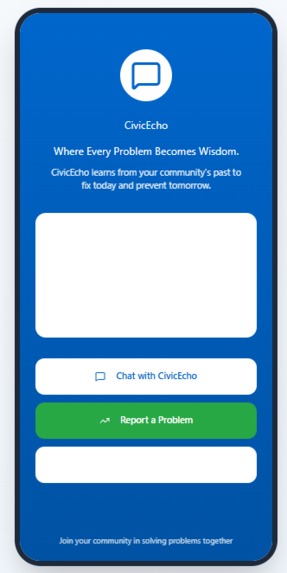
landing page
-
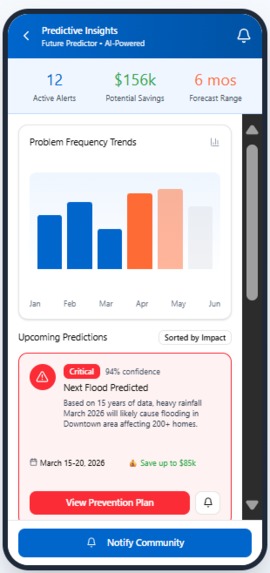
prediction board
-
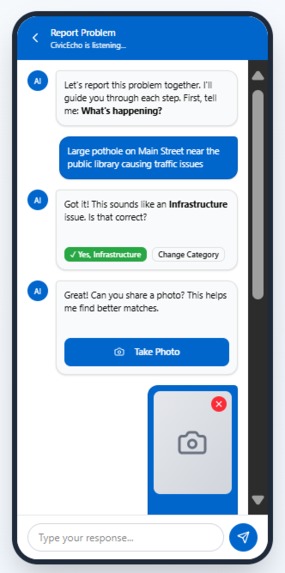
report a problem screen
-
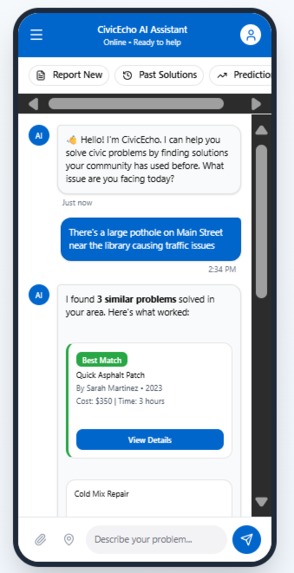
chat screen
-
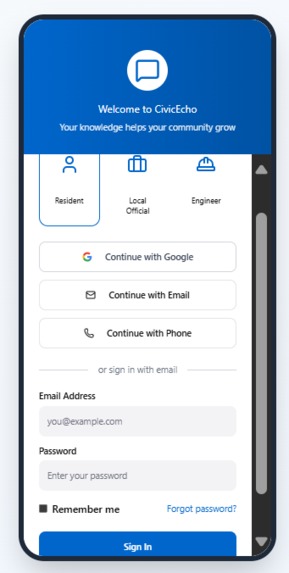
login
-
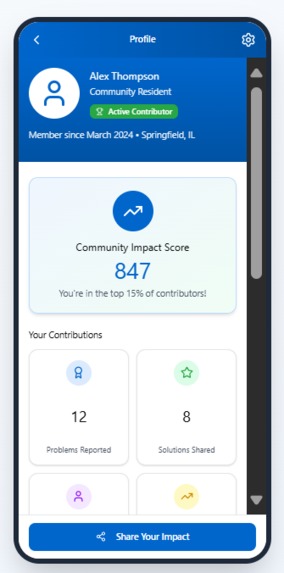
User Profile
-
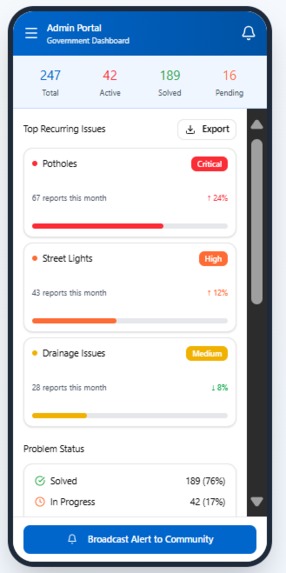
government dashboard


About the Project: CivicEcho, The AI Civic Problem-Solver (Ideathon)
The Inspiration
The core inspiration for CivicEcho came from recognizing a common, costly frustration in local communities: institutional amnesia. Many recurring civic problems (like seasonal flooding, road failures, or habitually broken public amenities) are often solved, forgotten, and then inevitably recur, causing local governments and resident groups to "reinvent the wheel." Our idea was to create a "community wisdom bank" A digital, AI-powered collective memory. We asked: "What if an AI could instantly recall the full history of a specific problem (who solved it, the cost, the outcome) and apply that knowledge to the challenge being reported today?" This led to the concept of a chat-based, predictive platform that connects past data to present action and future prevention.
What We Learned (During Conceptual Design)
Designing CivicEcho reinforced several key lessons about civic technology and data design, even before writing the first line of code:
- The Value of Context: A simple problem report ("Pothole on Oak Ave") becomes incredibly powerful when contextualized with history. We learned that the platform's success hinges on retrieving and presenting actionable historical data instantly via a simple conversational interface.
- User Segmentation is Critical: We realized we needed two distinct experiences: Residents need a simple, chat-based reporting tool; Local Officials require a powerful, data-rich Predictive Dashboard. The design had to successfully separate and cater to these different needs (evident in our Login/Signup and Admin Portal wireframes).
- Data Visualization is Key for Action: The design process taught us that raw data must be immediately transformed into clear visual alerts and charts to motivate timely preventive action. For instance, calculating a projected failure date based on historical data can be made tangible by visualizing the average time to failure $T_{fail}$ using: $$T_{fail} = \frac{\sum_{i=1}^{n} \text{Duration}_i}{\text{Number of Solutions } n}$$
How We Theoretically Built the Project (Our Design & Technical Plan)
As this is an Ideathon concept, our "build" focused on the conceptual architecture and user experience design:
- Interface Design: We used an AI design tool to generate rapid wireframes. We established a clean, modern design with a white background and a blue/green civic color palette. The goal was to ensure the UI felt trustworthy, accessible, and highly focused on clarity.
- Core Chat Logic (Conceptual): We modeled the interaction where a user's free-text input (the current problem) triggers a semantic search function against a historical database. The theoretical backend would use Natural Language Processing (NLP) to categorize the issue and a Vector Database to retrieve the most relevant past solution.
- Data Structure Design: We meticulously designed the required database schema to track critical metrics for every issue: Category, Geospatial Coordinates, Estimated Cost ($\$), Duration of Solution, and Contributor. This rich structure is the backbone for the Solution Library and the Predictive Insights Dashboard.
Challenges We Faced
The project presented a few significant conceptual and design challenges:
- Balancing Simplicity and Depth: The main difficulty was designing the integration of complex historical data and predictive modeling into a simple, conversational, mobile-first chat interface. The AI's response had to be concise and immediately actionable, avoiding informational overload.
- Defining the Predictive Metric: We struggled with defining an intuitive metric for future risk. We chose to focus the design on visualizing recurrence frequency and time-based alerts rather than relying on complex, invisible algorithms, ensuring the predictions were transparent to the user.
- Visualizing the Data Flow: A key design challenge was visually communicating the journey from Past Solutions $\rightarrow$ Present Action $\rightarrow$ Future Prediction across the different screens (Chat, Solution Library, and Dashboard).
Built With
- figma
- powerpoint


Log in or sign up for Devpost to join the conversation.