-

Social Media with Only Facts
-
-
-



Inspiration
Over the past few years, we’ve seen all social media platforms struggle with rampant misinformation and fake news, perpetuated by claims based on unverified, untrusted, and unfounded sources. There have been concerted efforts by these platforms to fight this problem, but they are unable to intervene before these claims gain significant traction. The reason behind this inefficacy is simple – social media was never built to deal with misinformation. Thinking back on our experiences in academic research, we realized that it was an almost perfect example of a community devoid of fake news. Each and every claim that a researcher makes is backed by citations from respected and trustworthy sources, which ensures that these claims are grounded in fact. This gave us the inspiration to build a social media platform that would deliver an experience of civic discussion grounded in fact to our community.
What it does
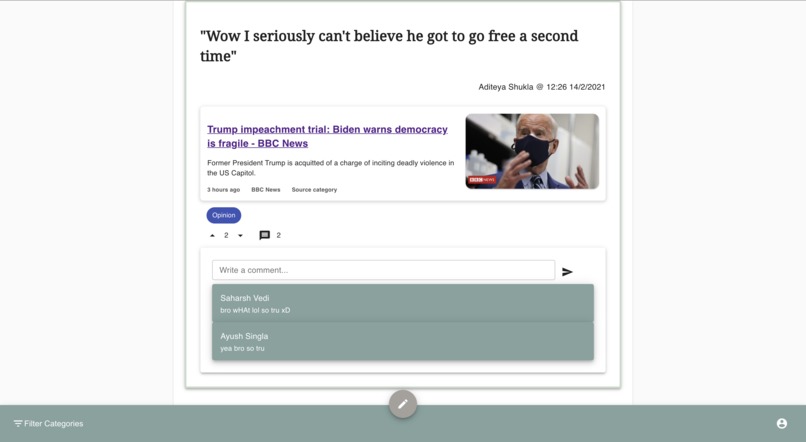
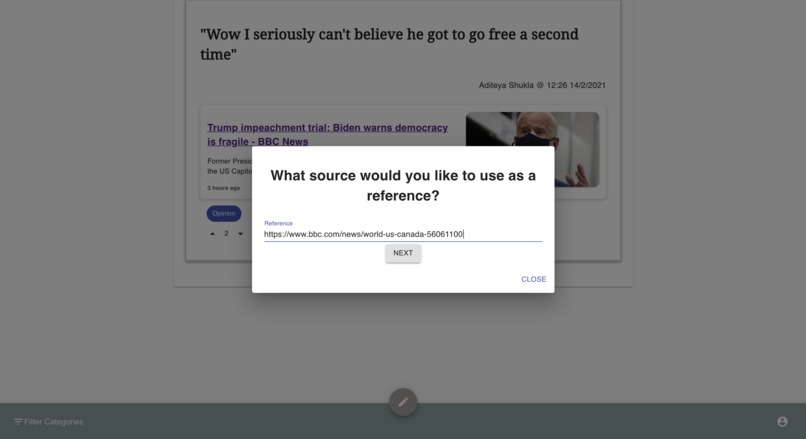
We plan to limit misinformation on our platform by using what has worked for centuries in academia - citations. Before adding their own opinion, the user would be asked to provide a reference, which would subsequently be fact-checked using a combination of human curated and ML/AI tools. Once verified, the user would be asked to cite the passage on which their claim is based, before sharing it with the world. By encouraging the user to post an opinion or an argument based on claims that are factual - we are bridging the gap between polarized ends of society seen today. On other social media platforms, due to the fact that the claims of both sides are so different in terms of their foundations, they are rarely able to engage in civil discourse across the aisle.
How we built it
We used React, in conjunction with Flask, to develop our platform. For our DB needs, we turned to Firebase and Google Cloud, while our fact-checking process was powered by the Google Fact Check and FakeBox APIs. Additionally, we were able to quickly add a subscription-based model using the Checkbook API.
Challenges we ran into
Our main challenge was ensuring that sharing a claim was challenging enough to severely limit any fake news from entering the feed, but intuitive enough to ensure that people were able to easily add their vetted citations and references, thus building a community where even a populace as polarized as ours could participate in spirited fact-based discussions.
Accomplishments that we're proud of
Due to illness, one of our hackers was unable to contribute any code throughout the hackathon, putting extra pressure on the other hackers. With this, considering our lack of ‘hacking’ experience and the scale of our hack, the fact that we were able to complete the minimum viable product within the timeframe of the hackathon was unbelievable. Moreover, helping solve an issue close to the hearts of many with a hack inspired by our time in academic research put a cherry atop the cake.
What we learned
We learned about the foundations of social networking, and how to plan and execute their nested data structures, as well as the integration of the front and backends of a web-app.
What's next for Factually
Future work would focus on refining the user experience, and developing an in-house fact-checking pipeline.
Built With
- checkbook-api
- firebase
- flask
- google-cloud
- python
- react


Log in or sign up for Devpost to join the conversation.