-
-
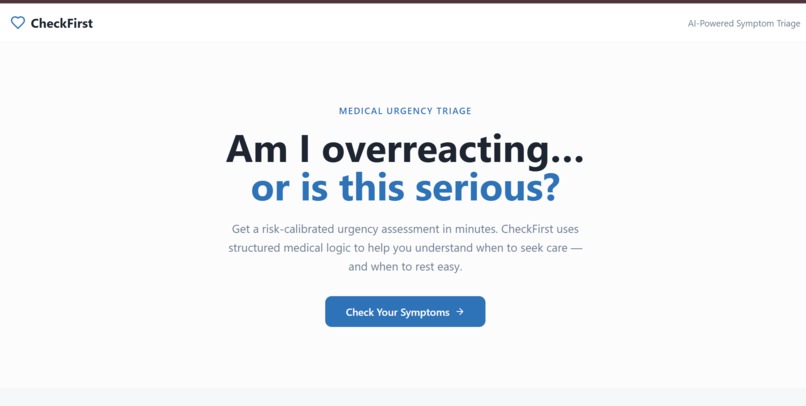
Landing Page
-
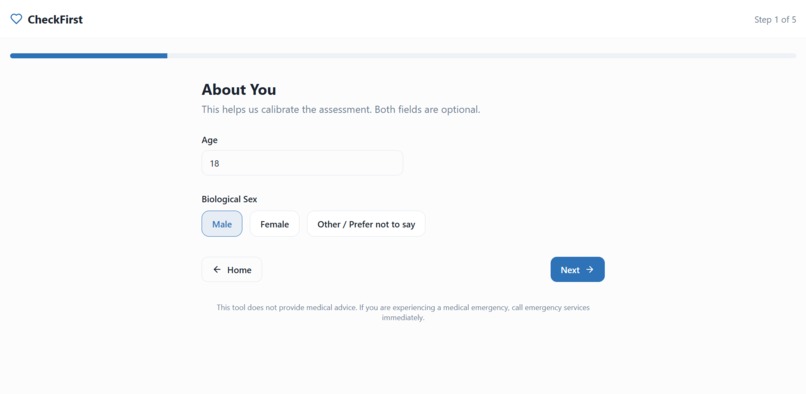
Step 1
-
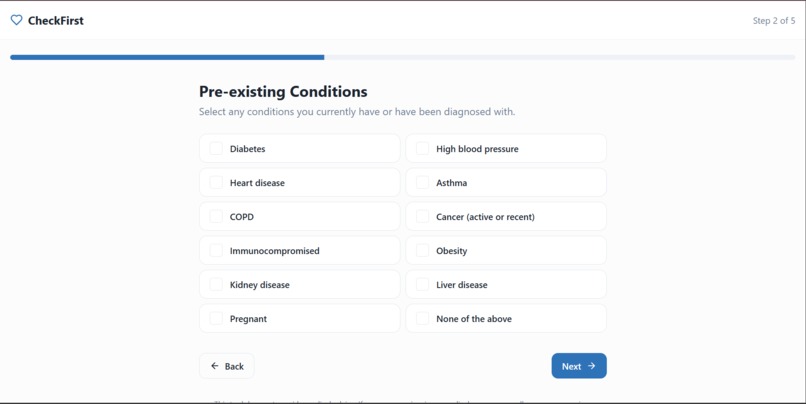
Step 2
-
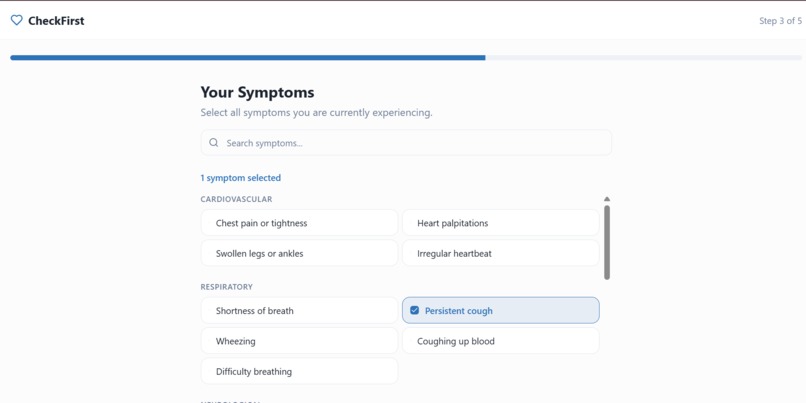
Step 3
-
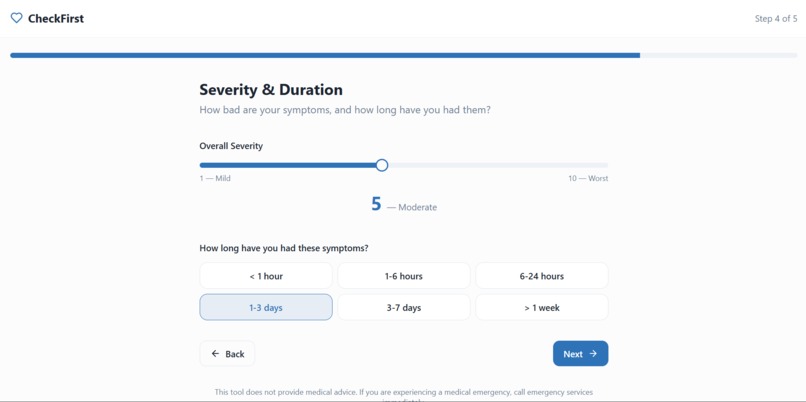
Step 4
-
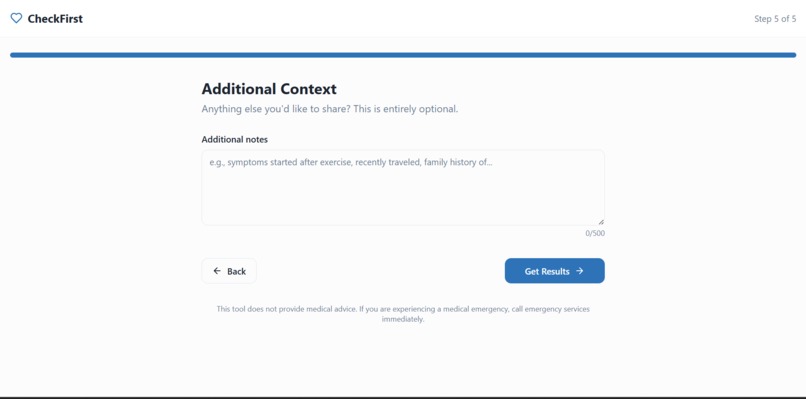
Step 5
-
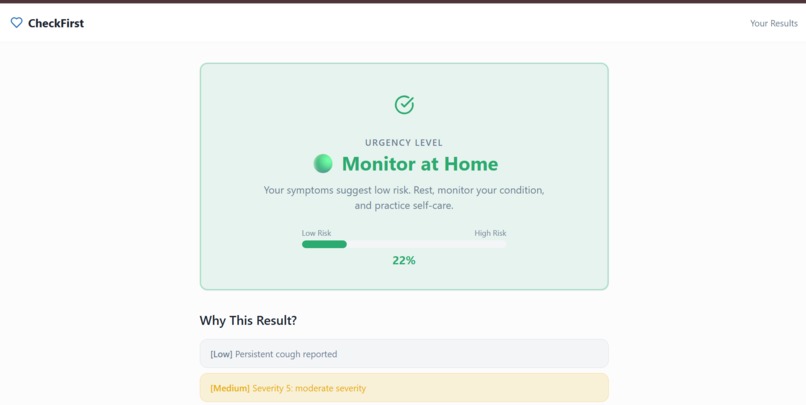
Results
-
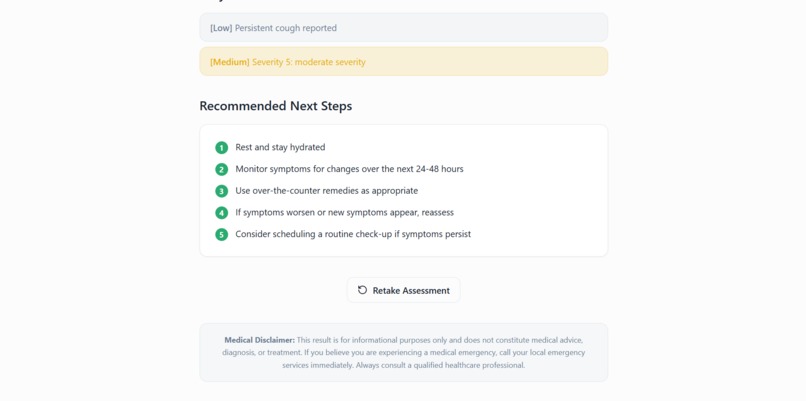
Recommended next steps


CheckFirst
AI-Powered Medical Urgency Triage
What Inspired Us
It usually begins with a quiet question.
A headache that lingers.
A tightness in the chest.
A fever that refuses to leave.
In that moment, a person stands between two risky choices: ignore it and hope it passes, or panic and rush to the emergency room. Both reactions can cause harm.
We realized the real problem is not diagnosis. It is uncertainty.
CheckFirst was built to reduce that uncertainty.
The Problem
Healthcare systems face two dangerous patterns:
- Underreaction → Delayed treatment → Severe outcomes
- Overreaction → Emergency room overload
People lack a structured, accessible, and explainable way to assess medical urgency before seeking care.
The gap exists between symptom onset and professional consultation.
How We Built It
1. Structured Risk Modeling
We designed a weighted risk scoring function:
$$ RiskScore = (W_s \times Severity) \times AgeFactor \times DurationFactor \times ComorbidityFactor $$
Where:
- $W_s$ = base weight of symptom
- Severity = user-reported intensity (1–10)
- AgeFactor = multiplier for high-risk age groups
- DurationFactor = escalation over time
- ComorbidityFactor = existing medical conditions
This allows structured reasoning instead of keyword matching.
2. Symptom Interaction Modeling
Symptoms rarely act alone. Certain combinations dramatically increase risk.
We modeled interaction effects as:
$$ CombinedRisk = \sum_{i=1}^{n} W_i + \sum_{i \neq j} Interaction_{ij} $$
This captures high-risk clusters such as:
Chest pain + sweating + shortness of breath
→ Elevated cardiac risk
This makes the system context-aware.
3. Machine Learning Classification
We trained a supervised learning model (Random Forest / Gradient Boosting) using structured triage scenarios.
Input features:
- Encoded symptom vectors
- Severity score
- Duration
- Age
- Known medical conditions
Output classes:
- Monitor at Home
- Consult Within 24–72 Hours
- Urgent Care Needed
- Emergency Attention Required
4. Explainable AI Layer
In healthcare, explanation is essential.
We implemented feature attribution scoring:
$$ Importance(feature_i) = \Delta Prediction\ when\ feature_i\ changes $$
The system displays:
- Which symptoms influenced the result
- Why escalation was triggered
- What changes would increase urgency
Transparency builds trust.
Challenges We Faced
Balancing Safety and Precision
Over-escalation causes panic.
Under-escalation causes harm.
We carefully calibrated thresholds to remain conservative for high-risk patterns while avoiding unnecessary emergency recommendations.
Ethical Boundaries
CheckFirst does not diagnose conditions.
It does not replace medical professionals.
It provides structured urgency guidance.
Ambiguous cases default toward recommending professional consultation.
Bias Mitigation
Medical risk varies across age groups and genders.
We adjusted risk multipliers to prevent systematic underestimation of symptoms in historically underdiagnosed populations.
What We Learned
- In healthcare, explainability matters more than complexity.
- Small uncertainty can lead to severe consequences.
- Responsible AI must prioritize safety over confidence.
Our Vision
CheckFirst is not a substitute for a physician.
It is a bridge between uncertainty and action.
If we reduce even a fraction of dangerous delays or unnecessary emergency visits, we contribute meaningfully to public health.
Clarity, in moments of fear, can save lives.

Log in or sign up for Devpost to join the conversation.