-
-
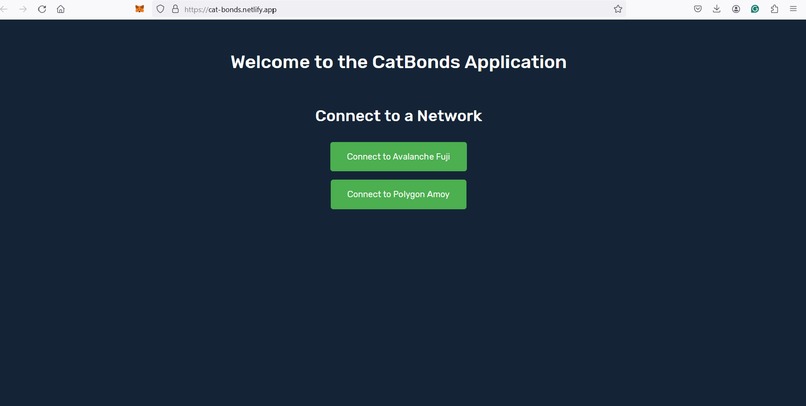
Wallet Sign In
-
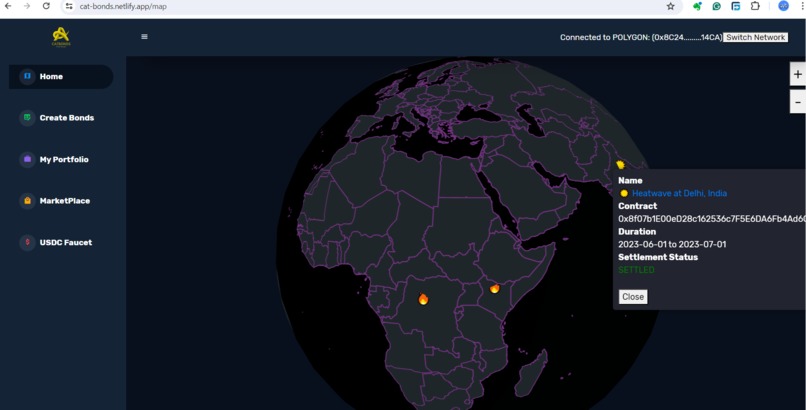
Bonds Map
-
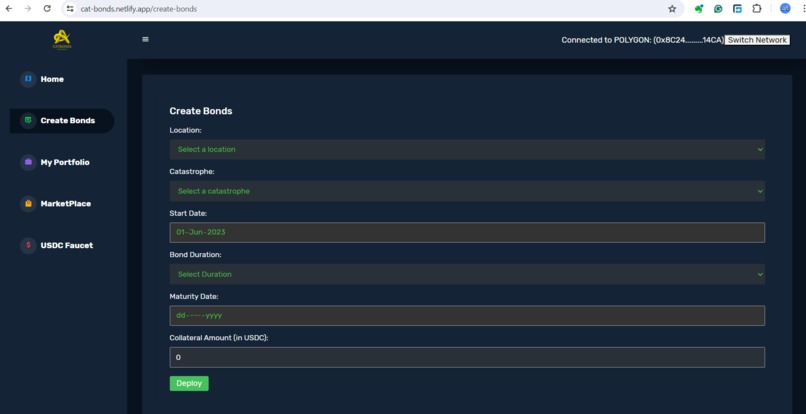
Create Cat Bond
-
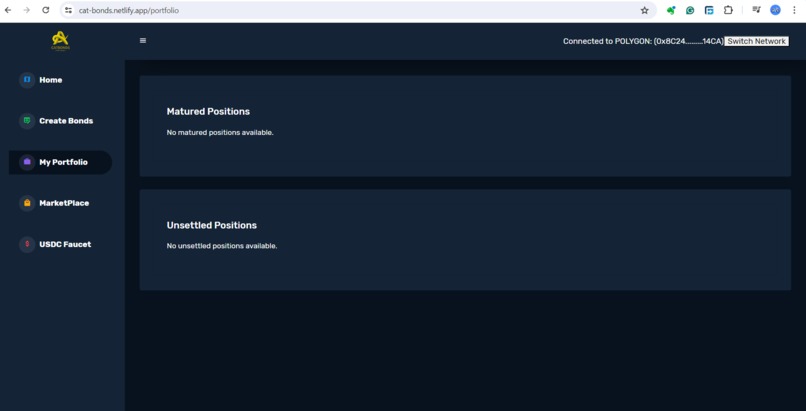
Portfolio Page
-
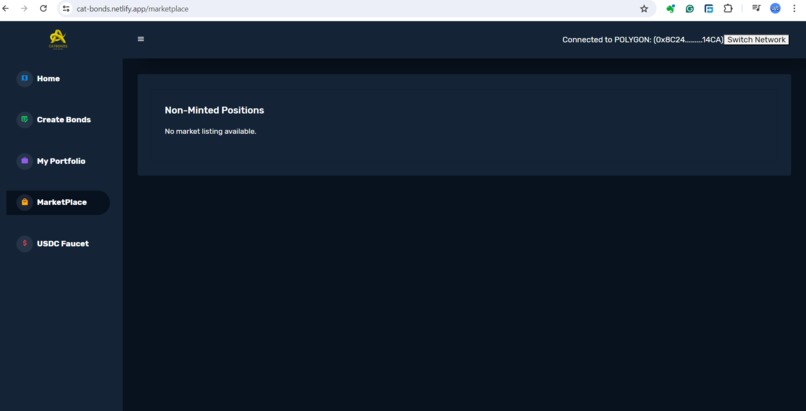
Primary Market
-
CatBonds Logo
-
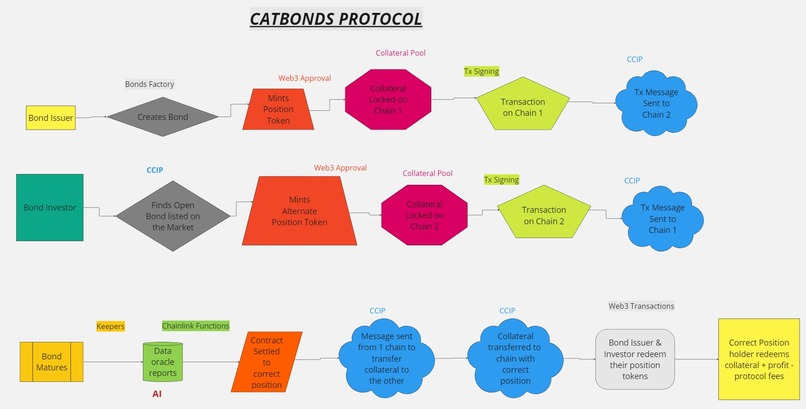
Protocol Workflow


Inspiration
We were inspired to create this protocol by the pressing need to build climate resilience as losses from climate change rise year on year. We aim for this protocol to help many governments, businesses, and individuals around the globe to better hedge their climate risks. Another inspiration is providing a new market that is uncorrelated to the main treasuries, equity, and property markets. Investors can use this CatBonds protocol to hedge against systemic risks in those traditional markets by investing in climate catastrophe bonds which are uncorrelated assets.
What it does
Catastrophe Bonds (shortened CatBonds) are an example of insurance-linked securities. They are used by insurance companies and governments to transfer big risks such as climate catastrophes to the capital markets. Catastrophe bonds are needed to transfer risks that the traditional reinsurance industry is unable to cover, such as climate disasters, to the capital markets which are much bigger and thus better able to absorb such risks.
Through CatBonds Protocol any entity can issue parametric climate catastrophe bonds. These bonds can be bought by investors through a market. Market participants mint tokens representing either the long or short position on a bond. The collateral they commit to a bond is held by a smart contract that is triggered by a specified catastrophe. An AI-powered catastrophe oracle reports whether the catastrophe occurred or not at the maturity of the bond allowing bond settlement in favor of one of the positions. The holder of that position token is then able to redeem both their and the other party's collateral less the protocol's fees.
This CatBonds protocol takes the entire catastrophe bond workflow and moves it on-chain where it can be executed in a permisionless and trustless manner. This protocol will attract institutional capital seeking uncorrelated investments through Cat Bonds into DeFi thus leading to capital inflows into crypto.
This is an MVP of the protocol designed as a proof-of-concept. There are many improvements and features lined up for development in the project's roadmap as we develop the protocol into a fully capable alternative to the off-chain catastrophe bonds market.
Read our whitepaper for more details on the project roadmap and vision.
How we built it
We built this using Chainlink technology, in particular the below components:
Chainlink Functions. These are used in implementing the data oracle. A service using an AI geospatial foundation model analyzes satellite imagery to determine if a climate risk has occurred for a given area. This AI has been fine-tuned to detect catastrophes such as wild-fires, floods, droughts, and heatwaves. The results of this AI inference are fed through Chainlink Functions to the smart contracts that require real-world data to trigger the contract's logic.
Chainlink Keepers. These are used for implementing automation in relation to the Chainlink Functions based oracle above.
CCIP protocol. It is used to implement CatBonds as a cross-chain application across Avalanche and Polygon networks. CCIP is used to send messages cross-chain during the execution of the catastrophe bonds. It is also used to transfer the value held in the collateral tokens cross-chain upon settlement of the bond contract. By leveraging CCIP we can pool capital from multiple chains into the protocol enabling more liquidity to converge in the bond market and more trades to occur. We also allow more degens to participate in the app regardless of which network they hold their assets. We plan to use CCIP in future to unlock higher returns for investors using our protocol through DeFi yield farming. This would allow us to increase the efficiency of the capital locked in the protocol generating attractive yields for investors.
Challenges we ran into
The time to finality for transactions was long on some chains which impacts user experience. We also faced some timeouts with the Chainlink Functions connected to our AI when the AI took a bit longer to perform inference for large areas. This can be fixed by increasing the timeout period for Chainlink Functions.
Accomplishments that we're proud of
We are proud of deploying the first trustless protocol for CatBonds and believe this will usher in new opportunities for DeFi investors while simultaneously providing a new avenue to hedge against climate disasters for those at risk.
What we learned
We learned how to use Chainlink functions and Keepers for our AI-powered oracle and also how to leverage CCIP to build a cross-chain protocol. We realized we only had enough time during the hackathon to build a stripped-down proof of concept for the protocol. Through working on this solution we learned just how big the opportunity is for this protocol and so intend to continue developing it post-hackathon.
What's next for CatBonds Protocol
We are going to refine the MVP and add in all the other features outlined in the roadmap. We'll do a security audit and then deploy the protocol on mainnets. We will also do business development for the protocol and bring on early users that have expressed interest in trialing the protocol.
We intend to raise funding to continue the development of this protocol into a full Web3 project. You can check out the whitepaper for the details of the protocol's roadmap as well as the tokenomics. Join our Telegram group (linked below) to get involved in the open development of the protocol, access the whitepaper, and be part of the community.

Log in or sign up for Devpost to join the conversation.