-
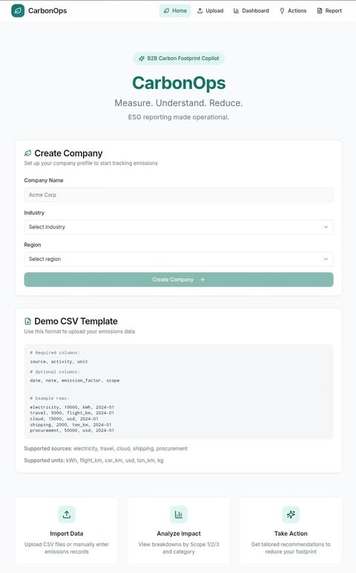
Dashboard of CarbonOps

Inspiration
CarbonOps was inspired by how many companies want to act on sustainability but struggle with fragmented carbon data spread across energy bills, cloud infrastructure, travel, and suppliers. We noticed that sustainability efforts often stop at ESG reporting for compliance, rather than being used to guide real operational and financial decisions. We wanted to build a tool that makes carbon data actionable and ties environmental impact directly to business value.
What it does
CarbonOps is a B2B carbon footprint copilot that helps businesses measure, understand, and reduce their emissions in one centralized dashboard. Companies upload operational data such as energy usage, cloud spend, travel, and logistics, and CarbonOps categorizes emissions across Scope 1, 2, and 3. The platform highlights emissions hotspots and provides actionable recommendations that show both potential carbon reduction and cost savings.
How we built it
We designed CarbonOps as a lightweight, hackathon-ready MVP focused on clarity and usability. We structured the product around a central dashboard that ingests operational inputs and maps them to standardized emissions factors. From there, we built logic to categorize emissions by scope and surface insights through visualizations and recommendations. The focus was on making complex sustainability data simple, transparent, and decision-ready.
Challenges we ran into
One major challenge was balancing accuracy with simplicity. Carbon accounting can become extremely complex, especially for Scope 3 emissions, so we had to carefully scope our MVP to remain realistic while still demonstrating value. Another challenge was ensuring the product went beyond reporting and clearly showed how sustainability actions could also reduce costs.
Accomplishments that we're proud of
We’re proud that CarbonOps reframes sustainability as a strategic business tool rather than a compliance burden. We successfully designed a solution that connects carbon impact to operational decisions and financial outcomes, while remaining realistic to build and demo within a hackathon timeframe.
What we learned
We learned how important it is to clearly define the problem before adding features. Simplicity, storytelling, and business relevance mattered just as much as technical implementation. We also gained a deeper understanding of carbon accounting concepts like Scope 1, 2, and 3 emissions and how they apply to real businesses.
What's next for CarbonOps
Next steps for CarbonOps include adding automated integrations with cloud providers, accounting software, and travel platforms, as well as improving emissions accuracy with real-time data. Long-term, we envision CarbonOps evolving into a full sustainability decision engine that helps companies continuously optimize both their environmental impact and operational efficiency.

Log in or sign up for Devpost to join the conversation.