-
-
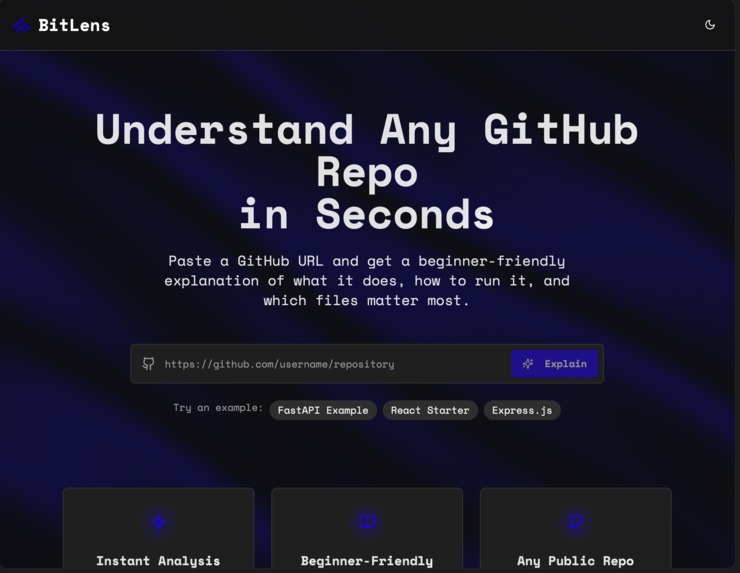
dark
-

light
-
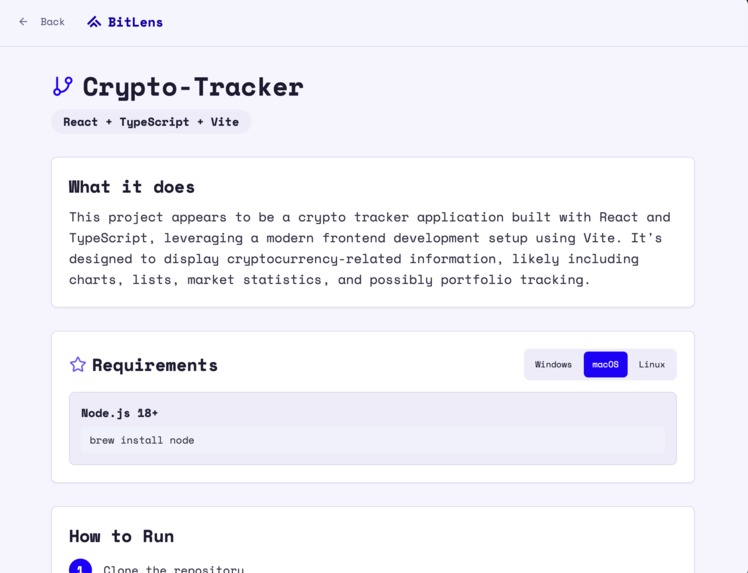
github link with no readme. p1
-
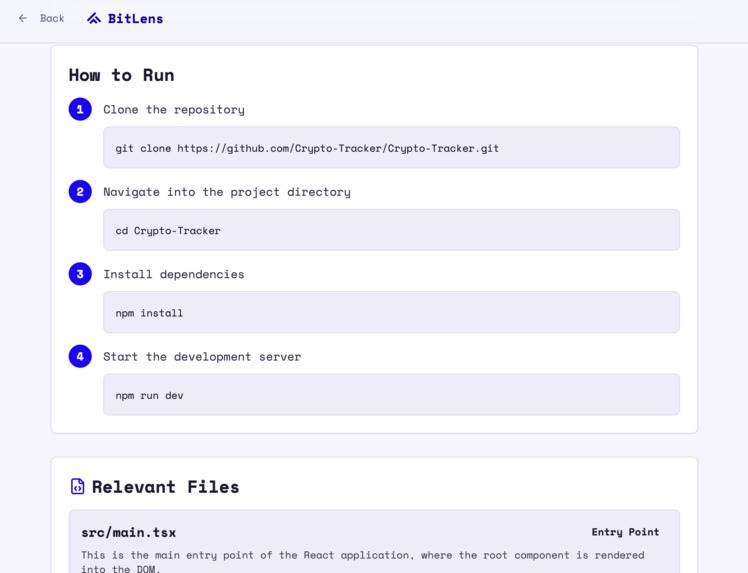
p2
-
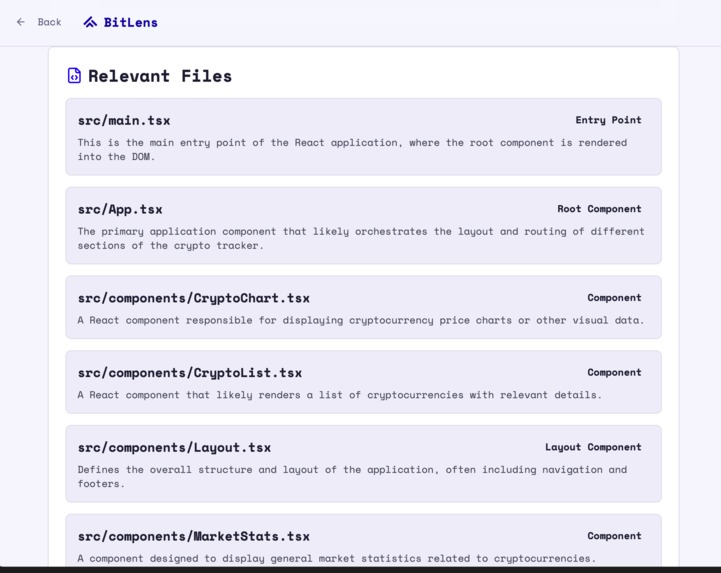
p3


🚀 BitLens — Turning Confusing Repos Into Clear, Human-Readable Guides
🌟 Inspiration
Every hackathon and project hunt starts the same way: you find an interesting GitHub repo… and then you’re lost.
The README is outdated, incomplete, or missing entirely. The entrypoint isn’t obvious. The commands don’t make sense.
In an era of vibe coding, where developers can clone anything but struggle to run basic commands, I wanted to build something that makes repos instantly understandable for beginners and intermediate coders.
BitLens was born from that frustration — a tool that translates any repo into plain English.
🛠️ How we Built It
We built BitLens as a web app using Lovable, leveraging its AI-assisted development workflow:
1. GitHub Integration
- Users paste a GitHub URL.
- The backend fetches:
- README (if it exists)
- File tree
- Entry points (e.g.,
main.py,app.js,server.js,index.tsx) - Manifests (
package.json,requirements.txt,pyproject.toml, etc.)
2. Automatic Entrypoint Detection
The app analyzes the repo structure to infer the primary language and framework.
If the README is missing, the system switches to “fallback mode” and extracts run instructions purely from:
- Script definitions
- File names
- Snippet content
- Common conventions per language
- Dependency files like
go.mod,Cargo.toml, etc.
3. OpenAI Reasoning Pipeline
All collected information is packaged into a structured prompt and sent to OpenAI.
The model returns a beginner-friendly JSON explanation with:
- What the repo does
- How to run it, step-by-step
- Required tools
- Key files and what they mean
- Extra notes for edge cases or missing information
4. Rendering the Explanation
The front end displays a clean, readable walkthrough with:
- Command blocks
- Beginner/Intermediate mode
- Translation of commands to simple language
(e.g.pip install -r requirements.txt→ “Install all the Python packages this project needs.”)
All output is designed to be accessible for new developers.
📚 What we Learned
- How to design clean back-and-forth pipelines with OpenAI and structured JSON.
- Best practices for GitHub API usage and repo inspection.
- How to guide AI systems to produce deterministic, high-quality output.
- How to build and iterate fast using Lovable’s Chat Mode and knowledge file system.
- The importance of clean UX for technical tools.
⚠️ Challenges Faced
1. Repos With No README
Many repos have no documentation at all.
I had to engineer a fallback analysis system to infer run instructions from the codebase alone — a surprisingly difficult problem.
2. Handling Diverse Tech Stacks
Every language has different conventions:
- Python has
__main__.py - Node projects depend on
"scripts"inpackage.json - Go always uses
main.go - Java apps hide the entrypoint in class definitions
Designing a universal detector took careful logic and prompt engineering.
3. Keeping AI Output Stable
LLMs love to “hallucinate.”
To fight this, I enforced:
- Strict JSON schemas
- Clear role instructions
- Chunking and token-control strategies
- Consistent system prompts
4. Building Quickly Under Hackathon Constraints
Using Lovable helped, but I still had to:
- Break features into small steps
- Revert broken versions
- Iterate on prompts
- Test across multiple repos
to ensure reliability.
🎯 Final Thoughts
BitLens bridges the gap between “I found a cool repo” and “I know how to actually run this.”
It empowers beginners, speeds up onboarding, and turns GitHub from a maze into a map.
Whether you're learning, hacking, or building, BitLens helps you move from confusion to clarity — instantly.
Built With
- gemini
- lovable
- supabase
- typescript
Log in or sign up for Devpost to join the conversation.