-
-
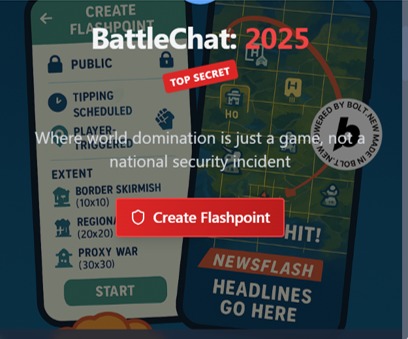
Landing Page
-
SignIn
-
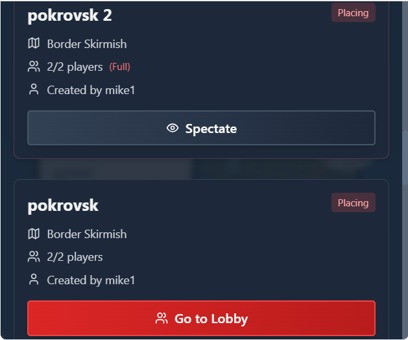
Flashpoints-Spectate
-
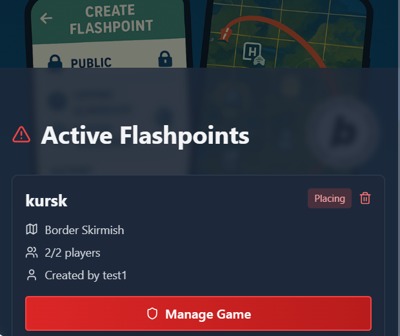
Flashpoints
-
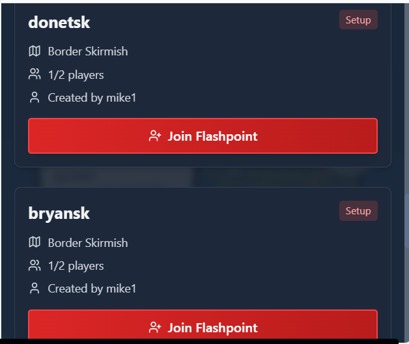
Flashpoints-Manage
-
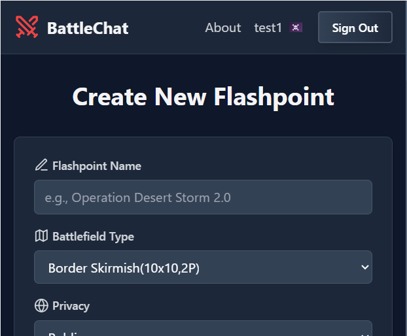
Flashpoints-Create
-
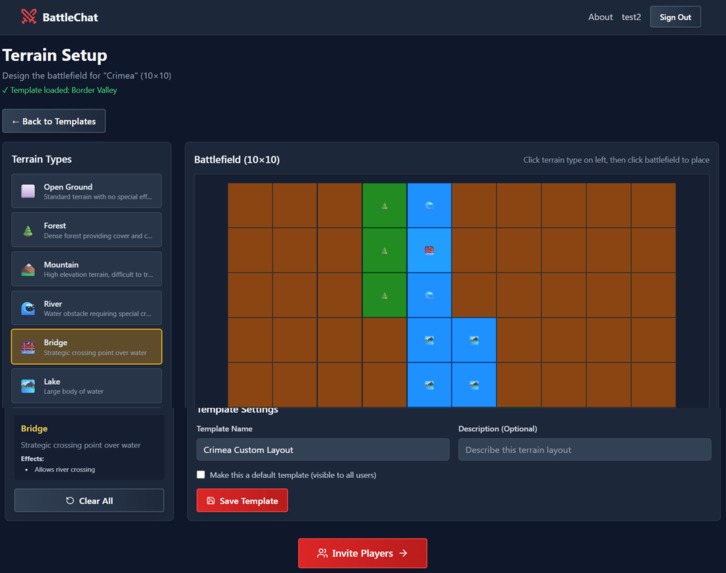
Terrain Placement
-
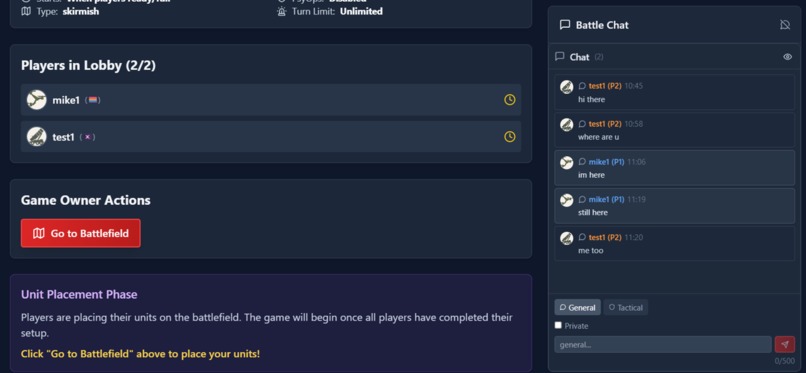
Go to Battlefield
-
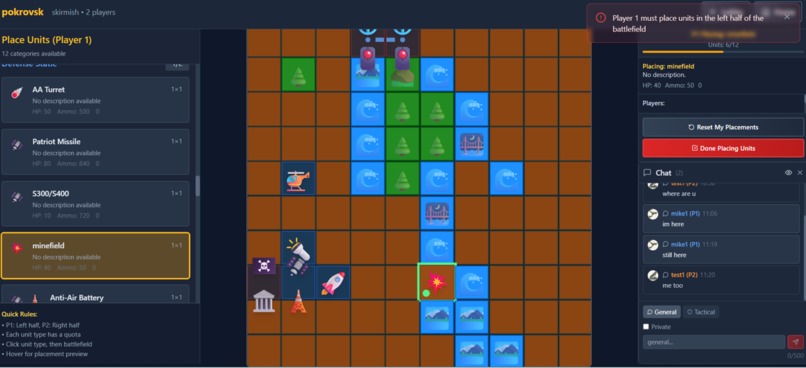
Place Units


BattleChat
This submission presents the BattleChat MVP: A strategic war game that doubles as our first prototype validating the concept of AI-mediated advertising (See About menu in the game):
Core Features Delivered:
- User authentication (sign-up/login)
- Comprehensive game setup and lobby system
- Interactive battlefield terrain placement
- Strategic unit positioning interface
- Integrated group chat functionality
This foundation is the base for our beta launch defining both engaging gameplay mechanics and the community platform infrastructure necessary for transparent AI agent integration.
Inspiration
Since Ukraine's invasion began, I've been glued to war analysis videos and geopolitical podcasts. Three years later, conflicts still keep erupting worldwide—Syria, India-Pakistan, Israel-Iran, and even border skirmishes between Thailand and Cambodia where I live.
All this real-world tension, propaganda, and human suffering became overwhelming. I needed a healthier outlet for my sanity —so I built a war game instead. At least now arm-chair generals can test their ideas without real consequences. My inspiration is to donate initial sales to support war victims in Ukraine. I dedicate this submission to my good friend, frontline medic and Sumy survivor - Mariaa Kartseva.
While researching AI players for Battlechat, I stumbled upon something bigger: A new advertising model that replaces data harvesting with transparent, value-added sponsorships through AI agents. Instead of extracting value from users, these agents add genuine utility to authentic connections.
BattleChat is my first prototype to prove this vision: 'Community platforms can thrive by serving users rather than exploiting them.'
What it does
see also the About menu item in the game
BattleChat is a turn-based, strategy game where each player sets up and defends their own battlefield while attacking others. It's Battleship meets geopolitics—with a mushroom cloud of satire.
Game Creation
Users create a Flashpoint: a game session with the following options:
- Privacy: Public (anyone can join) or Private (invitation only)
- Tipping Point: Time-based (scheduled start), Player-triggered (enough troops have ammased on the frontline)
- Extent: Border Skirmish (2 players, 10×10 battlefield), Regional Conflict (3 players, 20×20) Proxy War (4 players, 30×30), World War (5+ players, 50×50)
Other user configurable parameters such as:
- Allow PsyOps, select from available company sponsored AI agents
- Change default Unit Type allocation and grid size for different battlefield sizes.
Then sets up the battlefield with terrain tiles that may have effects on
- Movement: “passable by”, "cost"
- Stealth :"visibility”
- Defense: "protection against certain types of attacks"
Once everything is set up, the user can then invite others to join the game.
Gameplay
Player Setup
Each player places their units on the battlefield:
- Attack units placed on their starting positions
- Targets: military and civilian (e.g. HQ, bridges, depots, troop gatherings) deployed.
- Defenses: On alert (e.g. radars/electronic warfare, Patriot, S-400, bunkers)
Initially, players only see their units on the field. Eventually through gameplay, they slowly become visible to all.
Turn Mechanics
Each turn (per player or team) consists of:
Defense Phase: Move mobile defense units Activate or deactivate auto trigger capabilities (e.g., radar, EMPs); Repair damaged defenses
Attack Phase: Move attack units Plan & launch attacks along defined paths Return unit (unless destroyed/intercepted)
Intercept Phase: If attack units falls into the radius of a defense unit with auto trigger capabilities, the attacker will automatically be hit by the defense unit. Otherwise (no auto-trigger), the defending player has 30 seconds to initiate an intercept
PsyOps Phase: PsyOps do not deal damage, but instead manipulate gameplay. They often require reveal phases or specific units like journalist drones, satellite verifiers, or propaganda-proofing upgrades.
They can cause random effects such as cooling delays or false alerts.
Examples include but not limited to: Economic Sanctions, Military Aid, False Flag attacks, Fake news, Ceasefire request, Humanitarian missions, Prisoner exchange
- Reveal Phase: Units revealed if hit, launching attack, or passing through defense zone False targets may be exposed or removed
Passive Players
Games can have passive players. Passive players can only perform Psyops operations. Their active team-mate places an embassy for them on the battlefield. Destroying an embassy takes the passive player out of the game.
A special type of passive player is an AI agent who has detailed knowledge of the gameplay and group chat. Users can choose to involve the AI agent or not.
AI agents are sponsored by organizations or commercial entities that wish to promote their products and services. They serve triple purposes:
- Community Enhancement: Providing specialized knowledge, tools, and assistance relevant to group interests
- Transparent Monetization: Enabling sustainable platform operations through clear, value-added sponsorships
- Authentic Engagement: Creating advertising experiences that feel like helpful participation rather than intrusive interruption
I believe this is the first in the next wave of online advertising innovations after google search. It's transparent, invoked only upon invitation and provides relevant inputs based on the gameplay and chat conversations; An AI agent for example can say "We’ve been playing for more than 3 hours now, would you like me to order pizza?"
Non-intrusive useful targeted advertising. Sponsored AI agents access a commercial LLM with the sponsor's message in the system prompt and utilize RAG to send the gameplay and conversations so that it can determine it's next step.
How we built it
As a solo developer, I leveraged a powerful AI toolkit:
- Claude for brainstorming game mechanics and business strategy
- Gemini for comprehensive game design and database architecture
- ChatGPT for debugging and troubleshooting
- Bolt.new for rapid code development
My development approach was iterative: I started by having Bolt create a group chat foundation, then integrated Gemini's game design to build the core Battleship mechanics. New features emerged organically from strategic discussions with Claude, particularly around AI-mediated advertising monetization.
I pushed Gemini to create a data-driven architecture that supports diverse unit types (targets, defenses, attacks) with customizable attributes—movement patterns, ranges, fuel/ammo systems, damage mechanics, and area effects. This flexible foundation will eventually allow users to develop or import their own unit configurations.
Supabase was phenomenal—it reminded me of dBase3, the first tool I used decades ago to build a PC-based telex system. Supabase provided seamless backend provisioning, vector database support for AI agents, and built-in scalability.
Last minute update!
see also the About menu item in the game
While developing BattleChat, I discovered ElevenLabs' Conversational AI capabilities and realized I've stumbled upon something revolutionary. What started as a simple strategy game has evolved into the first prototype of AI-mediated advertising—where brands add genuine value through intelligent voice agents rather than exploiting user data.
The Perfect Synergy Elevenlabs technology transforms BattleChat into a new advertising paradigm. Corporate sponsors can use ElevenLabs' RAG integration to create their own agent personas
- Newscaster summarizing end of turn events
- War Correspondents delivering battlefield analysis, Intelligence Analysts providing tactical insights,
- Logistics Coordinators managing real-world player needs.
These aren't just branded voices; they're genuinely useful services powered by each company's actual knowledge base and real-time data.
Market Validation Ready I've designed multiple conversational agents and integrated ElevenLabs into our architecture. Using their comprehensive documentation and AI assistant, full implementation is straightforward—accelerating our path to sponsor partnerships and market validation. BattleChat proves that advertising can serve rather than surveil.
Success here can position ElevenLabs at the forefront of the post-cookie advertising revolution, opening doors to every community platform seeking ethical monetization alternatives.
Challenges we ran into
The trickiest issues weren't in the code itself, but in the lack of knowledge on the environment: incompatible module versions, unsecured Supabase connections, and configuration problems. I made the mistake of treating these as coding problems instead of using chat-based troubleshooting. This led me down debugging rabbit holes, adding unnecessary statements and occasionally breaking working functions. ChatGPT became my lifeline through extensive trial-and-error sessions.
Accomplishments that we're proud of
After 30+ years in software development, I'm amazed that tools like Bolt.new and my "AI trio" (Claude, Gemini, ChatGPT) keep me competitive with modern development practices. The learning curve for new technologies has never been gentler.
The MVP demonstrates a compelling product concept ready for strategic investment to complete beta launch.
What we learned
No-code tools are powerful but still maturing. They excel at straightforward applications like websites but require substantial upfront design and guidance for complex systems. However, they're rapidly improving and serve as exceptional learning platforms for understanding modern development patterns.
What's next for BattleChat
Our MVP demonstrates a compelling product concept ready for strategic investment to complete beta launch. Development progress:
- Game Concept: 80% complete—requires additional features to attract corporate AI agent sponsorships
- Beta Development: 60% complete—needs enhanced gameplay mechanics and AI integration
Phase 1: Proof of Concept (Beta Launch)
Launch BattleChat as a demonstration platform proving AI-mediated sponsorship viability in gaming communities. Establish brand partnerships while measuring user engagement, satisfaction, and commercial effectiveness.
Go-to-Market Strategy: Offer beta access in exchange for donations to war victim relief efforts, driving adoption while supporting our humanitarian mission.
Phase 2: Commercial Launch
Deploy full BattleChat platform with corporate-sponsored AI agents. Implement subscription tiers and payment systems while maintaining a robust free tier supported by transparent AI agent monetization.
Phase 3: Platform Expansion
Validate AI-mediated advertising across diverse community applications:
Family Heritage Groups Partner with genealogy companies, photo services, and educational publishers. An Ancestry.com-sponsored AI agent could organize family photos into heritage albums, suggest research paths, or facilitate intergenerational storytelling—transparently beneficial to family connections.
Educational Communities Integrate with classroom group chats through partnerships with educational publishers and learning platforms. Pearson-sponsored agents could provide supplementary lesson plans, track student progress, and offer personalized learning support that genuinely enhances education.
Spiritual and Cultural Communities Deploy specialized AI agents trained on relevant texts and traditions. Buddhist communities might access agents versed in Buddhist scriptures, sponsored by meditation apps or cultural organizations, helping integrate traditional wisdom into modern discussions.
Phase 4: Infrastructure Scaling
Build comprehensive platform infrastructure supporting:
- Diverse community types and customization tools
- AI agent development frameworks
- Sponsor relationship management systems
- Partnerships with AI companies and specialized knowledge providers
Phase 5: Market Leadership
Target underserved communities while developing:
- Advanced AI capabilities and community management tools
- Sophisticated sponsor-community matching algorithms
- Market expansion into untapped community segments
Vision:
Establish the definitive platform for ethical, value-added community advertising that serves users rather than exploiting them.
Built With
- bolt.new
- elevenlabs
- github
- javascript
- lucidchart
- react
- supabase
- typescript

Log in or sign up for Devpost to join the conversation.