-
-

AURA
-
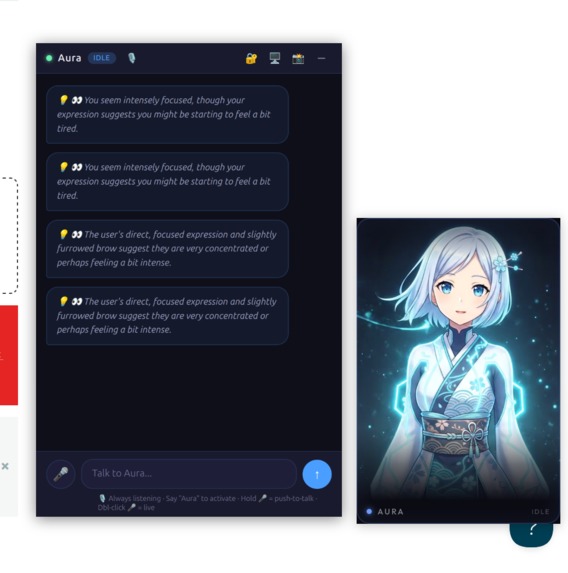
Chat interface
-
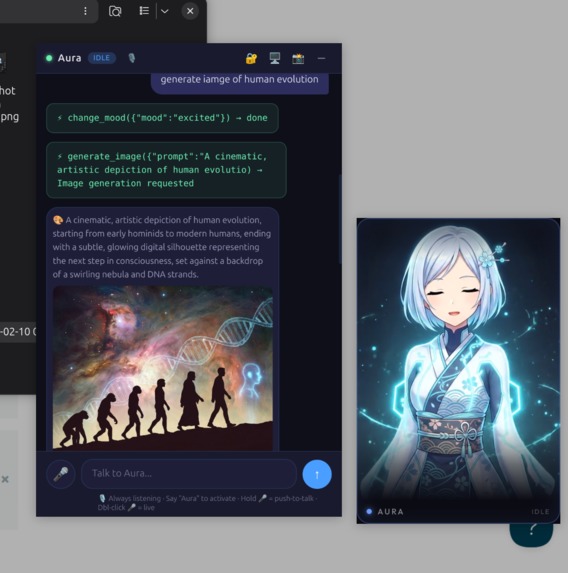
Image gen
-
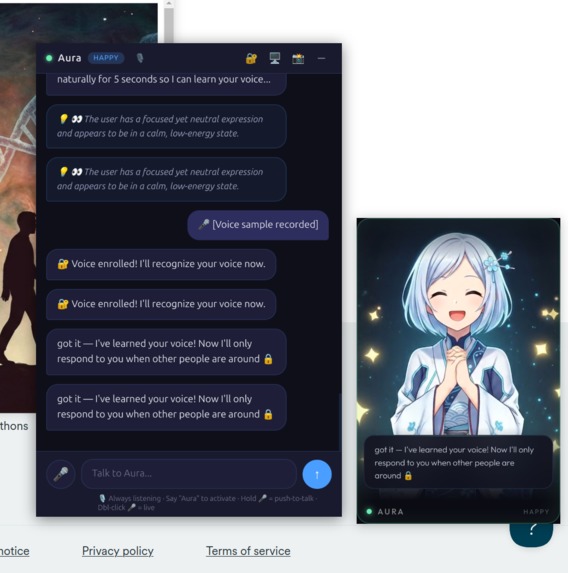
Voice recogonition engine


AURA — Latent Cognitive Elicitation Companion
Inspiration
Most modern AI systems are optimized to answer prompts, not to exist coherently over time. They respond well in isolated interactions, but fragment across sessions—forgetting identity, context, and intent. This limitation makes current AI assistants feel transactional rather than truly intelligent.
This project was inspired by our independent research, Latent Cognitive Elicitation (LCE), which explores a fundamental question: What if intelligence is not trained explicitly, but emerges when internal coherence is enforced?
Aura was built to test this idea in the real world—not as a chatbot, but as a persistent desktop companion that sees, hears, remembers, and reasons consistently across time.
What the Project Does
Aura is a Gemini-powered desktop AI companion that implements Latent Cognitive Elicitation as a working cognitive architecture.
Unlike traditional assistants, Aura maintains:
- A persistent identity
- Cross-session memory coherence
- A stable personality
- Proactive, causal reasoning based on screen, voice, and user behavior
Aura operates continuously on the desktop, observing context (with user consent), responding through text, voice, and visuals, and evolving its understanding of the user through a compressed, reflective memory system called the Soul Journal.
The result is an AI that feels consistent, aware, and adaptive—rather than stateless or reactive.
How We Built It
Aura is implemented as a desktop-first, multimodal system powered by the Gemini 3 ecosystem and a custom LCE layer.
Core components include:
- Gemini 3 Flash as the latent cognitive substrate for reasoning, vision, and function calling
- Gemini Live API for real-time, bidirectional voice interaction
- Gemini Pro Image for in-chat image generation
- Gemini TTS for expressive, personality-aligned speech output
- Offline Whisper ASR for privacy-preserving speech recognition
- Electron for the desktop companion interface
- FastAPI + WebSockets for real-time orchestration and tool execution
At the heart of the system is the Latent Cognitive Elicitation Layer, which enforces five cognitive pressure fields:
- Consistency Pressure — ensures cross-context coherence
- Identity Pressure — maintains personality stability across time
- Causal Pressure — enables proactive reasoning and intervention
- Epistemic Pressure — prevents contradictory beliefs and memories
- Compression Pressure — distills long interactions into meaningful reflections
Aura’s memory and identity persist locally through structured files (soul.json, memory.json, and a markdown-based Soul Journal), allowing long-term continuity without retraining.
What Makes It Novel
Aura is not just an application—it is a working implementation of original research.
Key innovations include:
- Latent Cognitive Elicitation (LCE) as a deployed paradigm, not a simulation
- A measurable Coherence Manifold that stabilizes behavior across modalities
- Dynamic skill creation at runtime, demonstrating emergent capability
- A Soul Journal that compresses experience into reflective identity memory
Quantitative evaluation using novel metrics such as:
- Cross-Context Coherence Score
- Identity Persistence Index
- Counterfactual Stability
- Emergent Reasoning Score
These elements move beyond prompt engineering into architecture-level intelligence elicitation.
Challenges We Faced
- Maintaining personality stability while allowing adaptation
- Preventing memory bloat while preserving long-term relevance
- Synchronizing real-time multimodal input without coherence collapse
- Designing evaluation metrics for concepts like identity and emergence
Balancing flexibility with stability was the core technical challenge—and directly validated the LCE hypothesis.
What We Learned
- Intelligence becomes more believable when coherence is enforced
- Memory compression is as important as memory accumulation
- Identity persistence dramatically improves user trust and engagement
- Gemini 3’s multimodal capabilities make real-time cognitive architectures feasible
Most importantly, we learned that coherence can be a stronger organizing principle than task optimization.
What’s Next
Future work includes:
- Multi-user identity adaptation
- Formal benchmarking of LCE metrics
- Expanded emotional state modeling
- Open-sourcing parts of the LCE evaluation framework
Aura represents an early but concrete step toward AI systems that are not just capable—but coherent, persistent, and meaningfully present.
Research Reference
Latent Cognitive Elicitation: A Coherence-Driven Paradigm for Artificial Intelligence Debasish, Independent AI Research, India — January 2026
Log in or sign up for Devpost to join the conversation.