-
-
page1
-
page3
-
page4


Atlas Axis: The Machine Economy OS
Inspiration
International students searching for apartments from another country face immense hurdles: lack of local credit history, difficulty in verifying property conditions remotely, and complex cross-border financial barriers. We built Atlas Axis on the Base chain to bridge this gap. By combining a digital twin city with a machine economy, we enable students to securely find, tour, and lease apartments in the Chicago Loop without needing to be physically present or have a traditional US bank account.
What it does
Atlas Axis provides a comprehensive digital solution for the future city, specifically optimized for the international student journey:
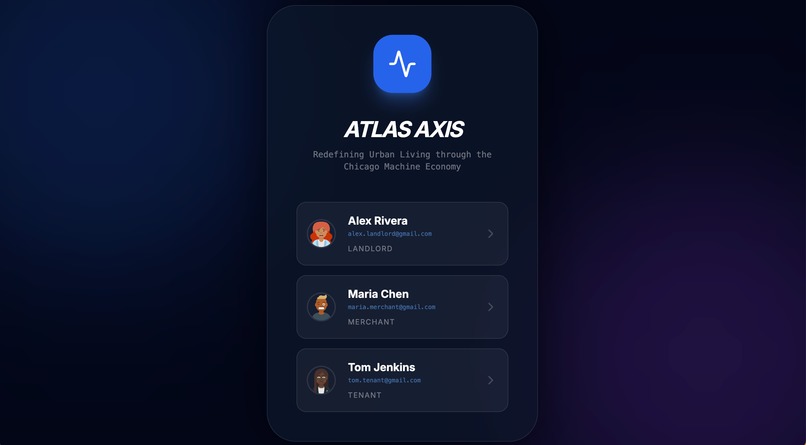
- Frictionless Onboarding: We simulated a logic using Gmail linked with third-party services, allowing students to generate an Agent DID and Crypto Wallet instantly, bypassing the need for an SSN during initial setup.
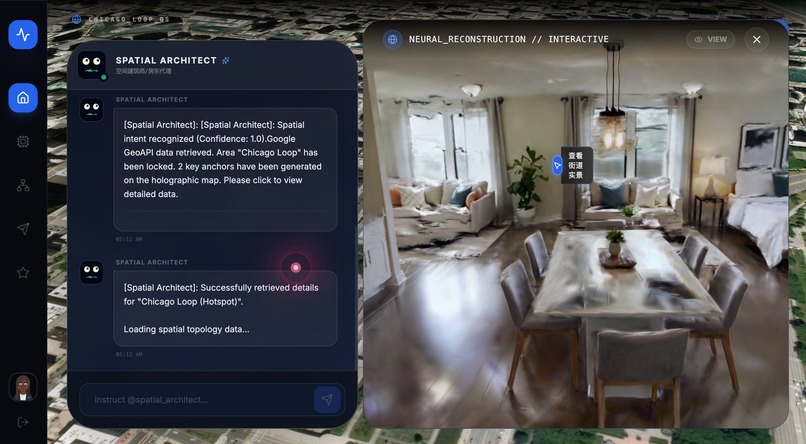
- Immersive Remote Touring: Leveraging Luma AI, students can explore high-precision 3D Neural Radiance Fields (NeRF) of apartments, seeing the actual lighting and textures from their home country rather than relying on misleading 2D photos.
- Trust-Based Machine Economy: Built on the Base Testnet, we utilized the 8004 Protocol to establish a Reputation Score for agents, ensuring students are interacting with verified, high-integrity spatial data and merchant services.
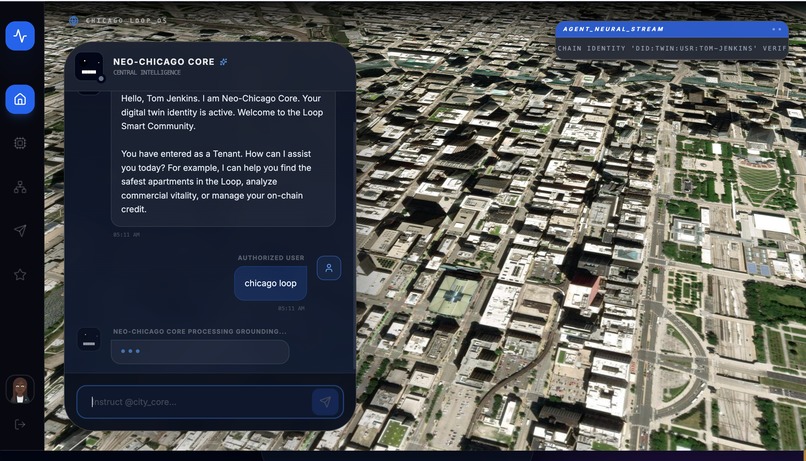
- Intelligent Relocation Support: Powered by the Neo-Chicago Core, the system dispatches the Spatial Architect to lock down geographic anchors and the Safety Sentinel to analyze neighborhood safety for students unfamiliar with Chicago's layout.
How we built it
- Luma AI Spatial Reconstruction: Moving beyond traditional manual modeling, we use the Luma AI API to transform captured video into high-fidelity 3D spatial data, supporting deep immersive interaction within the browser.
- Identity & Wallet Generation: We simulated the integration of Gmail authentication with a third-party wallet API to silently generate on-chain identities (DID) and non-custodial wallets upon agent creation.
- 3D Digital Twin Integration: We integrated the Google Maps API for macro satellite-level rendering, seamlessly nesting the micro-architectural spaces generated by Luma AI within the global map.
- Hybrid AI Logic: While we used AI Studio for rapid prototyping and prompt testing, we migrated the core logic to a custom React + Vite environment to handle complex Google Maps integrations and environment variable injections.
Challenges we ran into
- Sandbox & API Limitations: We initially struggled to get Google Maps fully functional within the AI Studio Sandbox due to strict environment constraints. We built a custom pipeline using Vite to ensure proper
VITE_environment variable injection. - Video-to-Spatial Alignment: Aligning the 3D scenes generated by Luma AI with the global coordinate system of Google Maps was a major challenge in spatial computing.
- Rate Limiting: Frequent deployments on Vercel led to 429 Throttling errors, which taught us to optimize our build cache and synchronization strategies.
Accomplishments that we're proud of
- Web2 to Web3 Bridge: Successfully triggered Agent identity and wallet generation via Gmail, completely removing the barrier to Web3 entry for international students.
- 8004 Protocol Implementation: Being among the first to apply a reputation protocol to AI agents, laying the groundwork for a trust-based machine society.
- Full-Cycle Transaction Loop: We used cryptocurrency to bridge the entire journey from viewing a property to signing a contract, making "Decentralized Living" a reality.
What we learned
- Scalable Machine Economy: We discovered how the low-gas environment of the Base chain allows for frequent, real-time reputation updates for large-scale agent swarms.
- Digital Twin Integration: We mastered the technical bridge between real-time geospatial data and interactive 3D modeling using Luma AI.
What's next for Atlas Axis
- Mainnet Transition: Moving from Base Testnet to Mainnet to facilitate real-world asset transactions.
- Global Promotion of the Credit Agent System: Expanding the 8004 Protocol to establish a universal credit standard for AI agents, enabling cross-platform reputation portability and trust verification.
- Social Recovery: Introducing social recovery mechanisms for wallets generated via Gmail to further enhance security.
- XR Expansion: Utilizing high-fidelity spaces from Luma AI to provide deep "virtual tour" experiences for devices like the Meta Quest.
Built With
- css
- gemini
- google-maps
- javascript
- lumaai
- python
- vercel


Log in or sign up for Devpost to join the conversation.