-
-
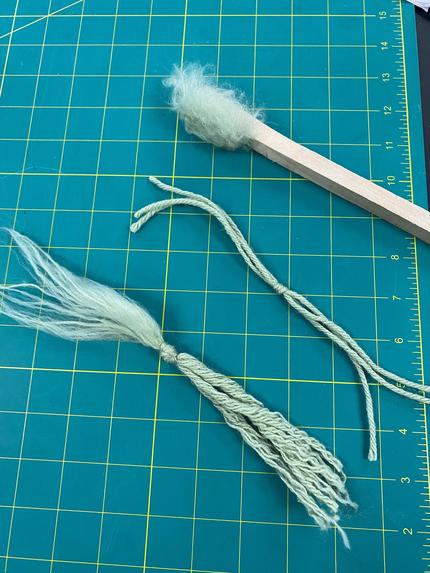
Brushing yarn into fur for the tail
-
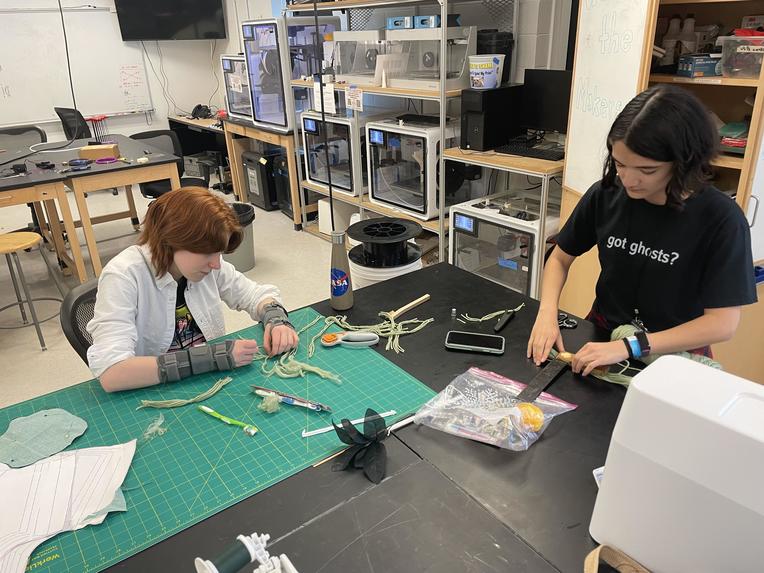
Brushing yarn into fur with extra help from our friend Tea
-
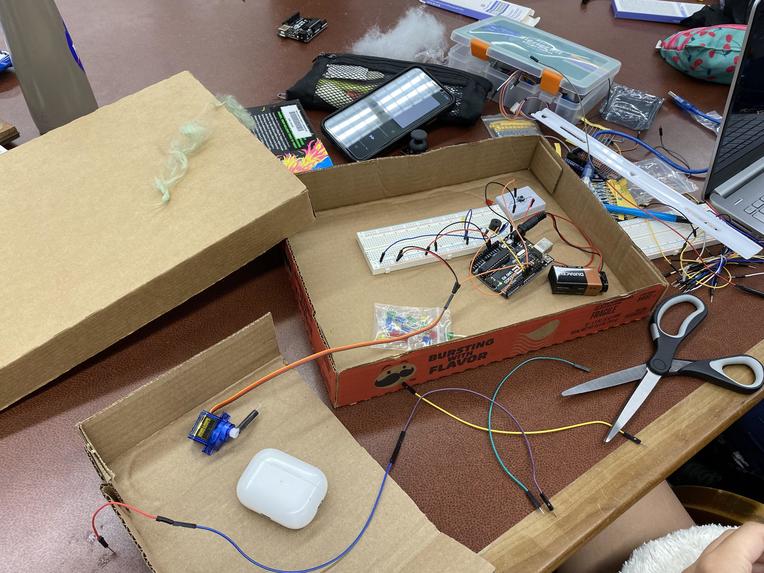
The circuit in process
-
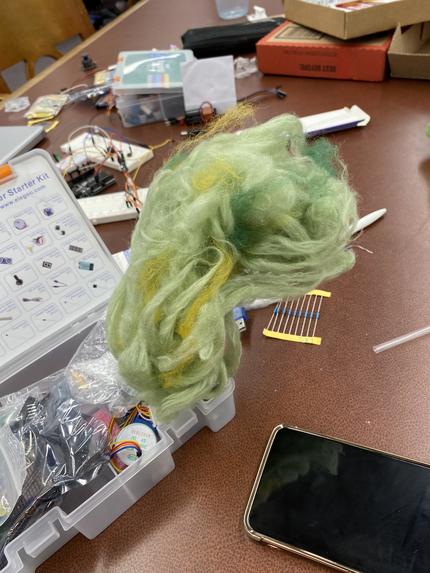
The finished, detached tail
-
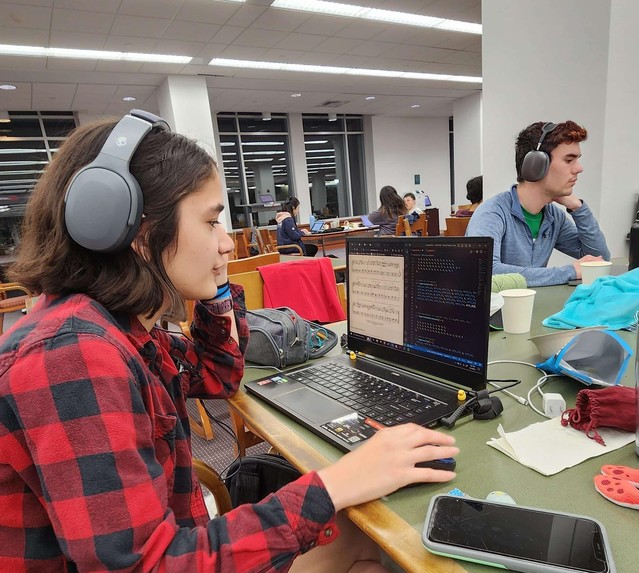
Elena transcribing the Alma Mater into a playable sequence in Arduino
-
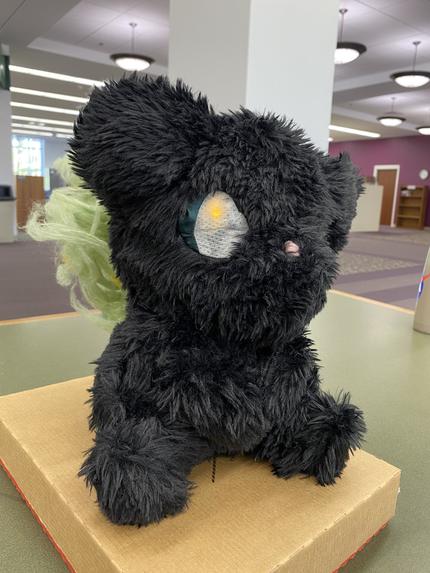
Milliam A. Wary finished with eye lights on
-
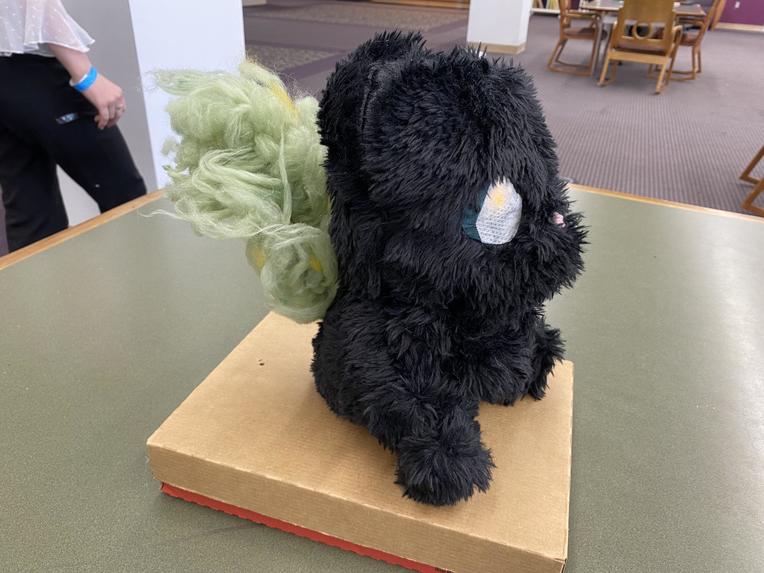
Side profile of Milliam A. Wary
-
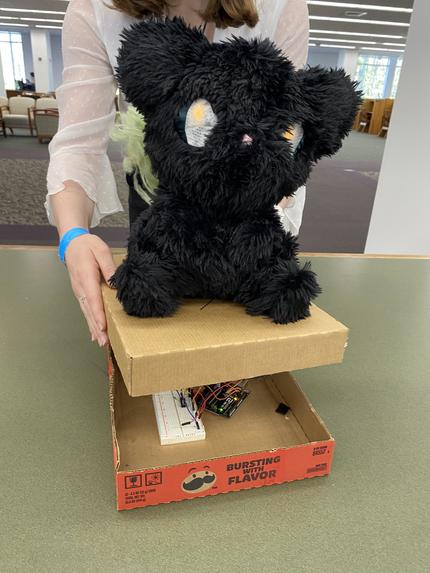
Looking inside Milliam A. Wary's platform
-
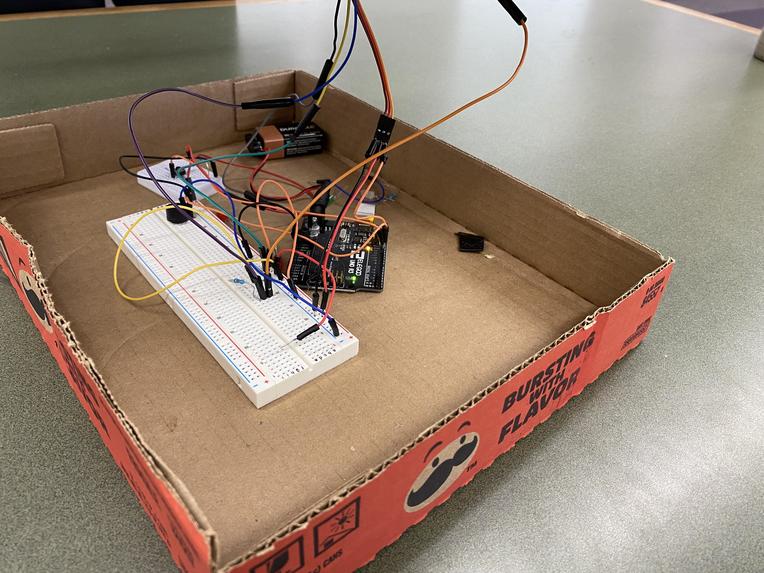
Inside Milliam A. Wary's platfrom


Inspiration
We wanted a way to combine our computational knowledge and Heather and Elena's knowledge of fiber arts. We also knew that we wanted to learn Arduino, so we came up with the idea of running some Arduino circuitry through a plush animal- an animaltronic!
What it does
The squirrel, Milliam A. Wary: 1) Has eyes that light up 2) Plays various tunes, including: William & Mary's Alma Mater, the Star Wars Imperial March, and Megalovania 3) Moves its tail
How we built it
Stacey and Aya built the basic circuit, and Erin (who is in an electronics class!) helped with the fine tuning and making it run as efficiently as possible. We programmed it using Arduino.
We then began brainstorming ways to place the circuits inside the stuffed animal, and started drafting the squirrel body pattern.
From there, the circuitry team continued working, building more features onto our base circuit and then debugging those new features.
Meanwhile, the body team found and scaled a pattern, designed eyes that would allow our LED eye colors to show through, and assembled the outer skin.
To prevent tail from being too heavy, we didn't use cloth or stuffing to make the tail. Instead, we brushed out yarn into wool fur for the tail, which we stuffed onto a wire for the shape and wrapped around a coffee stir for support.
Finally, we ran the circuitry into the squirrel skin, stuffed it, and placed it on its pedestal!
Challenges we ran into
There was no speaker available for the Arduino, so we couldn't easily upload soundbites. However, there was a sine buzzer, and we were able to tune the frequency to play tunes!
One of our biggest challenges was lack of material. Because we selected a hardware hack, and specifically a fiber arts based hack, there weren't a lot of resources for some of the things we wanted to do. But we called friends, brought in some of our own materials, and made use of the spaces available to us, especially the Makerspace.
Our other biggest challenge was the LED lights we wanted to use as eyes. It seemed as if every time we fixed the sine buzzer or the servo for the tail, the one or both of the LEDs would stop working. We originally wanted to make the eyes blink in different colors in time to the music, but there were too many problems along the development process with the eyes to implement this. Instead, we had to pivot to single color LEDs, but even then, the LEDs still were fickle.
We also ran into some difficulties while figuring out how to do our tail. We needed it to be fluffy and nice, but light enough for our motor to run. Eventually, we decided to brush out yarn, attach it to wire, and wrap it around a wooden coffee stirrer to make the tail you see now!
I (Heather) was working on the skin most of Saturday, and when I came back and asked the circuit team about the challenges they had faced, I just got a round of groans. Most of us are very new to circuits and Arduinos, so many times adding a new element would mess up everything already there, and we would have to find workarounds. The team mostly overcame this by thinking outside the box, and adapting on the fly (to quote Elena: "we learned to adapt very fast. We had to.")
Despite splitting up into teams (plush creation and Arduino) for most of the project, we still had collaboration between these teams and ultimately synthesis into one teams towards the end of the project.
Accomplishments that we're proud of
Our biggest point of pride in this project is all of the disciplines we were able to combine. Yes, Heather has sewn before, and yes, we've all coded before, but we've never tried to run wiring through a stuffed animal, much less build and code all that to do things. In the end, we combined more fields than we expected: sewing, coding, electrical engineering, puppetry, Arduino, and even music theory, as Elena had to manually transcribe every song that Milliam A. Wary, our animaltronic, can play. More than anything else, we employed problem solving.
Other small victories:
We got some great music going without a speaker!
We were able to tweak and adjust an existing sewing pattern to suit our needs.
We learned how to make fur out of yarn.
What we learned
We learned circuitry basics and wire management in order to assemble the breadboard for Milliam.
We learned so much stuff about Arduino! The language and the hardware is new for most of us, so that was very fun.
We also learned quite a bit about puppetry and working together to build a complicated object, especially one split up in software, hardware, and fiber arts.
What's next for Animaltronic
Sadly, Milliam A. Wary has to be disassembled after this competition, since we borrowed the Arduino from the hardware table. Some of the team would like to learn more about Arduino's and electronic puppetry to create a more permanent, refined animaltronic.
Built With
- arduino
- crochet
- felting
- sewing-machine


Log in or sign up for Devpost to join the conversation.