-
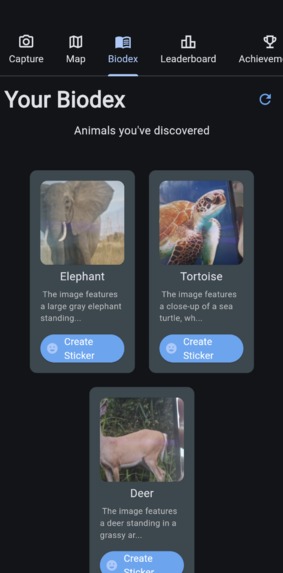
Biodex and Stickers
-
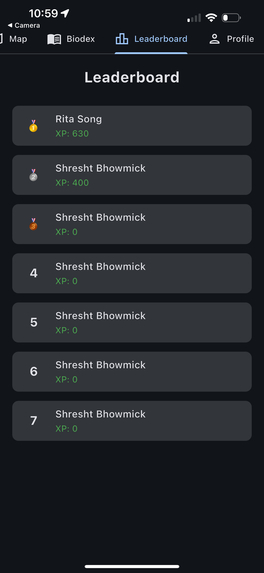
Leaderboard
-
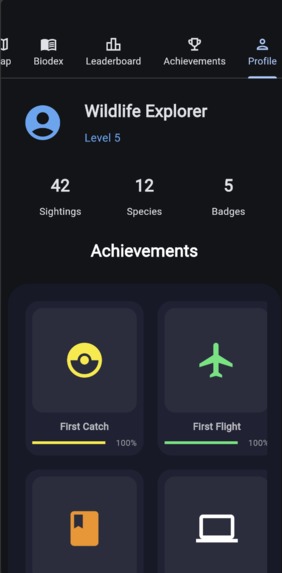
Profile and Achievements


Inspiration
The inspiration for AnimaGo came from the engaging mechanics of augmented reality games like Pokémon Go with real-world wildlife conservation efforts. Many people are passionate about gaming but may not engage with nature or environmental efforts in meaningful ways. By leveraging gaming mechanics, we can encourage players to explore the outdoors, learn about real animals, and contribute to conservation efforts while having fun.
What it does
AnimaGo is an augmented reality mobile game that allows users to discover, identify, and catalog wildlife in their surroundings. Players use their mobile devices to scan and recognize animals using computer vision and AI, earning experience points and achievements for each successful identification. The app features a "Biodex" where players can track their findings, a gamified capture system based on image quality, a leaderboard to encourage competition, and challenges to promote biodiversity tracking. AnimaGo also integrates conservation efforts by allowing players to donate to wildlife organizations and participate in real-world nature preservation quests.
How We built it
AnimaGo is built using a robust tech stack:
- Core Technologies: Python 3.11, uv, Flet, Firebase, FastAPI
- Computer Vision & AI: Moondream, OpenCV, PyTorch, YOLOv8, Segment Anything Model 2
- Geospatial & Mapping: GeoPy, Leaflet (via WebView)
Key features such as real-time animal recognition and AR overlays utilize YOLOv8 for object detection and the Segment Anything Model (SAM) for advanced image segmentation. Firebase handles authentication and data storage, while FastAPI powers the backend.
Challenges We ran into
One of the biggest challenges was optimizing real-time animal recognition to be both accurate and efficient on mobile devices. Additionally, using pre 1.0 version of Flet was restrictive with its features. Training and fine-tuning YOLOv8 models to work across diverse environments and lighting conditions required significant effort. Another challenge was integrating gamification elements in a way that felt rewarding without detracting from the core conservation mission. Lastly, ensuring user privacy while enabling location-based animal tracking was an important consideration that required thoughtful implementation.
Accomplishments that We're proud of
- Successfully integrating real-time animal recognition with an intuitive AR overlay
- Designing a gamification system that encourages exploration and conservation
- Implementing a global heatmap for animal sightings to contribute to citizen science
- Developing a sound recognition feature to identify nocturnal and hard-to-see species
- Enabling a donation system to support wildlife conservation efforts directly from the app
What We learned
Throughout this project, we gained a deeper understanding of AI-powered image recognition, geospatial mapping, and mobile app development. We also learned about the importance of user engagement in conservation efforts and how gamification can be a powerful tool for positive environmental change. Additionally, working with Firebase and FastAPI enhanced my backend development skills.
What's next for AnimaGo
Moving forward, we plan to:
- Expand the database to include more species and improve recognition accuracy
- Develop a PvP mode where guilds compete to document biodiversity in their region
- Introduce a "Species Discovery" feature rewarding players who identify new or rare species
- Improve AR overlays with interactive educational content about captured animals
- Partner with conservation organizations to create sponsored wildlife events
- Launch a colorblind-accessible mode and an “Education Edition” for schools