-
-
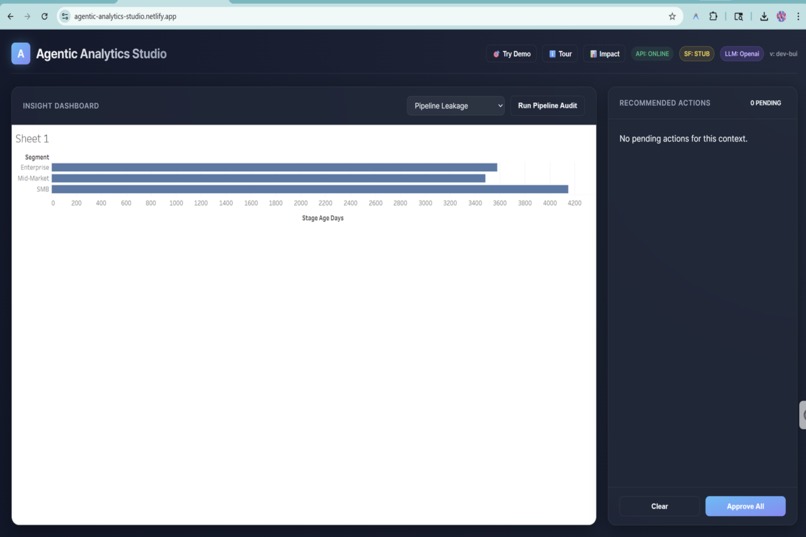
AAS embeds next to Tableau—pick a hero play, run it, and get action recommendations with trust signals.
-
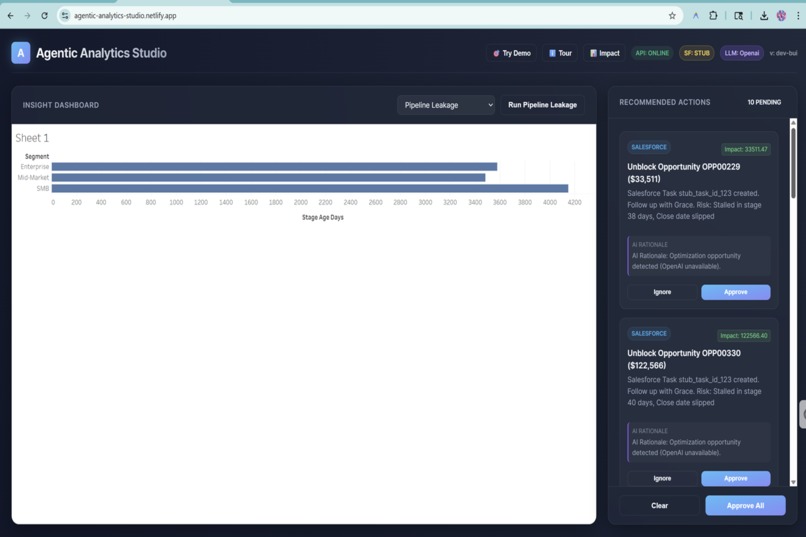
Pipeline Leakage: Stage Age Days by segment plus impact-ranked actions to unblock stalled deals fast.
-
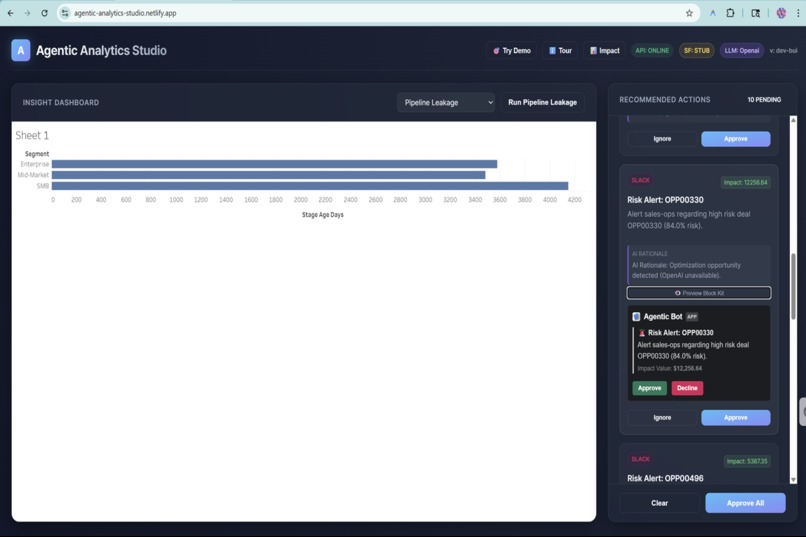
Slack action card: preview a drafted alert, then Approve/Ignore to keep humans in the loop.
-
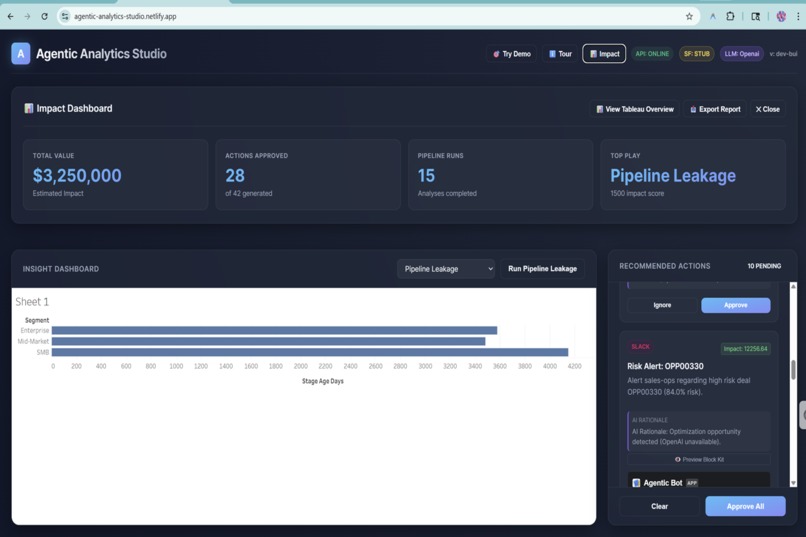
Impact Dashboard: total estimated value, actions approved, runs completed, and top play driving impact.
-
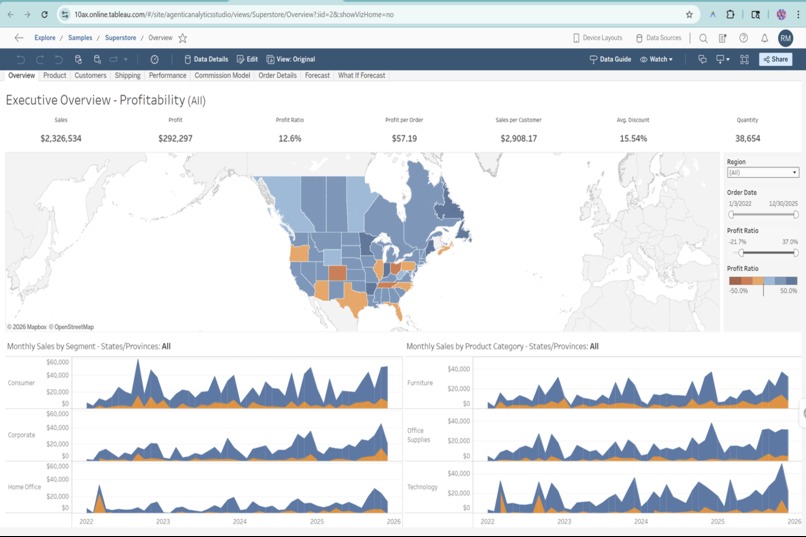
Tableau Overview: explore patterns with filters, then let AAS convert insights into next-best actions.
-
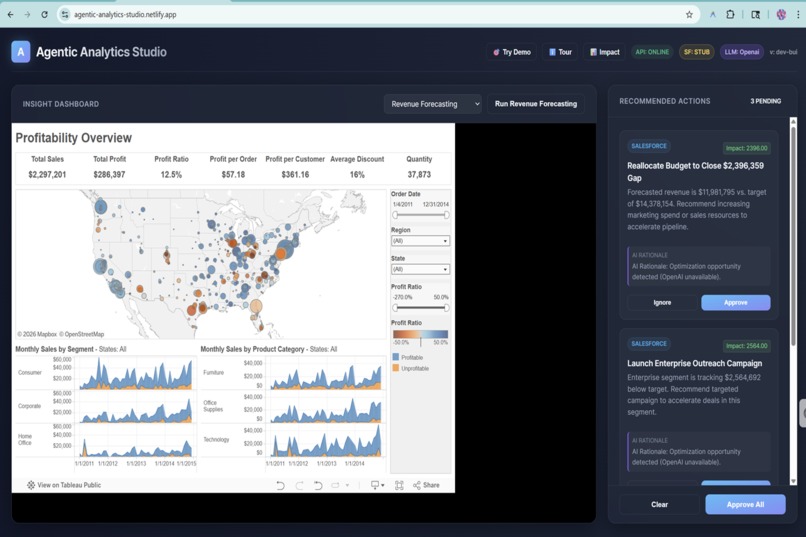
Revenue Forecast: identify the gap drivers and prioritize actions to protect and improve the quarter.
-
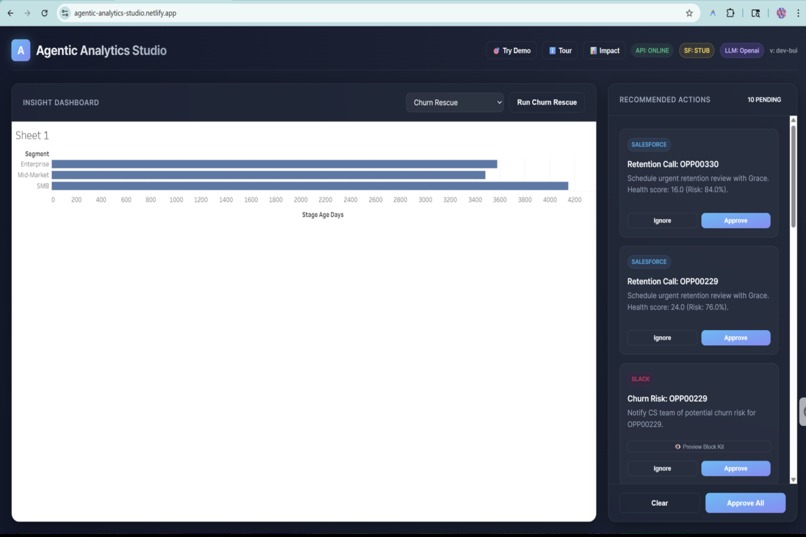
Churn Rescue: surface at-risk accounts early and generate retention actions before customers slip away.


Inspiration
Analytics dashboards often highlight potential revenue leaks or anomalies, but they rarely close the loop. We were inspired to build a tool that transforms insights into action by embedding AI-powered agents directly inside Tableau dashboards.
What it does
Agentic Analytics Studio (AAS) turns Tableau dashboards into an interactive workspace that recommends, prioritizes and automates follow-up tasks. Users select from a library of “her plays” that address common business problems:
Pipeline Leakage – audits CRM pipelines to find stalled or at-risk deals, estimates the financial impact, and recommends follow‑up tasks. Actions can be sent to Salesforce or Slack with an Impact badge and AI-generated rationale.
Churn Rescue – segments accounts by health score and product usage to identify customers at risk of churn, then suggests personalized retention plays and drafts renewal tasks.
Spend Anomaly – analyzes expense and purchase data to flag suspicious spending patterns or outliers, and notifies finance to investigate potential waste or fraud.
Revenue Forecasting – forecasts future sales based on pipeline and historical data to identify upcoming revenue shortfalls or surges, and recommends actions to increase pipeline value or adjust plans.
Customer Segmentation – clusters customers using product usage, demographics and engagement signals to identify high-value segments and recommend personalized marketing or retention plays.
Each action includes an impact score (estimated ROI) and an AI-generated rationale. If the configured LLM provider is unavailable, the system falls back to templated rationales.
A guided tour walks first‑time users through selecting a play, running an audit and approving a task. A live Impact Dashboard summarizes total estimated value created, actions approved, pipeline runs and top plays, and offers CSV/JSON exports. Status chips show the health of the API, LLM and Salesforce integration, with a new SF: Stub/Live badge indicating whether Salesforce is fully wired or running in safe preview mode.
Behind the scenes, a modular play registry makes it easy to add new plays with just a single file, and our LLM‑agnostic engine supports OpenAI, Ollama, Anthropic and Gemini providers or a deterministic fallback via centrally managed prompts. Interactive Slack messages leverage Block Kit with Approve/Decline buttons, while Salesforce tasks run through a safe stub/live gateway. The platform includes seeded demo datasets and scenario scripts, automated unit and integration tests with CI, and comprehensive documentation and architecture diagrams to encourage community contributions.
How we built it
The frontend uses Next.js/React with glassmorphic styling and Shepherd.js for the guided tour. We embed Tableau dashboards via the Tableau Cloud/Connected Apps embed API and run the backend using FastAPI and Express with Python and Node.js helpers. We designed a modular play architecture where new plays are registered with a simple interface (id, description, input schema, run()) so third parties can add their own. The agent layer supports multiple LLM providers (OpenAI, local Ollama or none) and gracefully degrades to deterministic rationales. Real tasks are executed via the Slack API or Salesforce REST API; when running in stub mode the app returns a preview of the request instead of calling Salesforce. Data is persisted in PostgreSQL on Vultr and the app is deployed on Netlify and Vultr with GitHub Actions for CI/CD.
Challenges and what’s next
Building live integrations without exposing credentials required careful environment variable management and stub/live modes, and quantifying ROI and impact scoring was challenging. We developed heuristics for pipeline value, churn risk, spend anomalies and revenue forecasting. Since then we have integrated additional LLM providers (Anthropic and Gemini stubs), implemented new hero plays like Revenue Forecasting and Customer Segmentation, built an Impact Dashboard with ROI exports, added interactive Slack messages with Block Kit, delivered a modular play registry and stub/live gateway, and seeded demo datasets with scenario scripts and automated tests. Next we plan to expand connectors (ServiceNow, HubSpot, email), introduce multi-language support and personalization, launch a marketplace for community-contributed plays, and enhance the analytics layer with longitudinal ROI curves.
Built With
- anthropic
- express.js
- fastapi
- gemini
- netlify
- next.js
- node.js
- openai-gpt-4
- postgresql
- python
- react
- salesforce
- tableau-embedded-analytics
- vultr

Log in or sign up for Devpost to join the conversation.