-
-
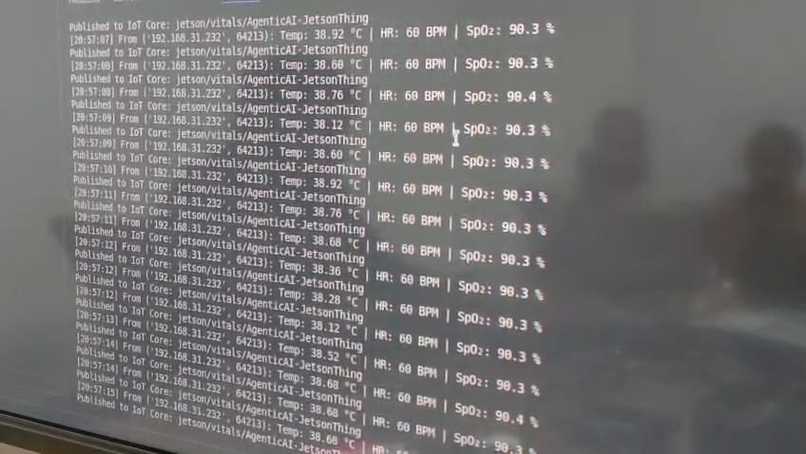
Jetson to AWS
-
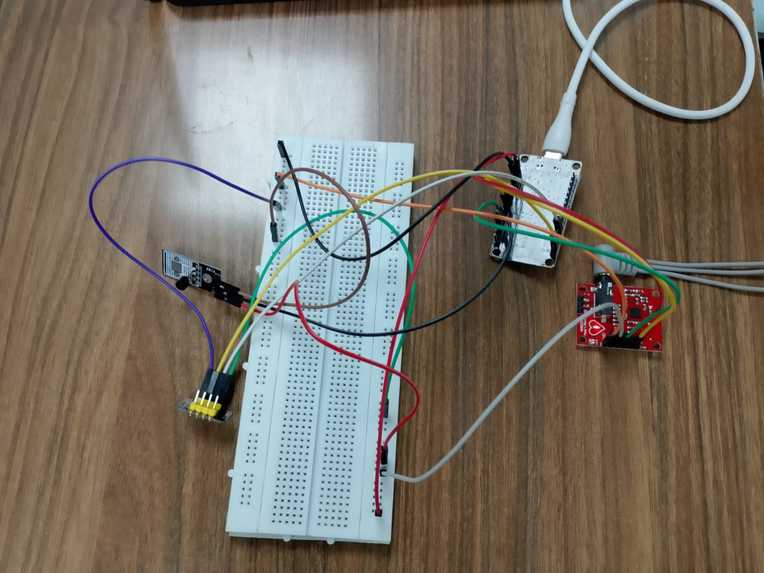
ESP32 HARDWARE SETUP
-
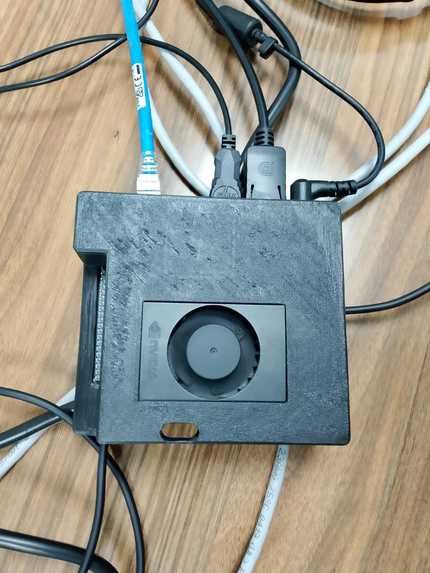
JETSON NANO
-
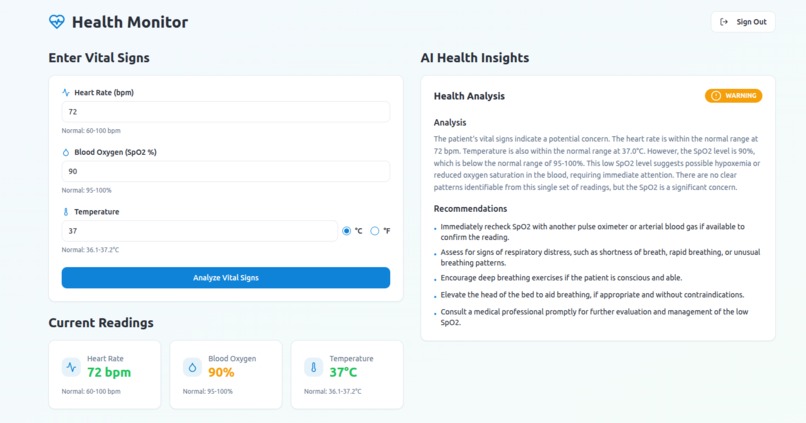
User interface


Inspiration
In today’s world, wearable devices can track heart rate or steps, but they still lack contextual intelligence — the ability to understand why something is happening or what to do next. We wanted to create a system that goes beyond passive monitoring to active health reasoning at the edge.
Inspired by agentic AI and the growing need for personalized, continuous, and privacy-preserving diagnostics, our team envisioned a wearable diagnostic assistant that doesn’t just collect data, but interprets, learns, and acts.
Our idea combines multi-sensor edge processing, agentic intelligence, and AI-driven diagnostics, enabling health insights without relying entirely on cloud connectivity.
What it does
AI-Enabled Diagnostic Assistant is a multi-sensor wearable system that uses edge-based agentic AI to monitor key physiological parameters and provide real-time diagnostic insights.
Each onboard sensor — temperature, SPO2, and ECG — functions as a local agent, performing edge-level reasoning. These agents collaborate through an on-device hub (Jetson nano) that fuses sensor data and communicates with a central AI diagnostic model for deeper insights.
The assistant can:
Continuously track vital signs (heart activity, temperature, SPO2).
Detect early health anomalies like stress, fatigue, overheating.
Provide on-device AI suggestions (e.g., “Take a break,” “Unusual ECG pattern detected”).
How we built it
We built the architecture around agentic AI on edge devices — where every sensor is an autonomous agent capable of local reasoning and communication.
Hardware Setup:
Temperature Sensor: LM35 – underarm/chest.
ECG Sensor: AD8232 (Analog) – inner left chest (fabric electrodes).
Edge Hub: Jetson nano.
Software & AI Architecture:
Local models perform anomaly detection (e.g. ECG irregularities).
Hub-level fusion model aggregates readings and performs contextual reasoning.
Cloud dashboard (optional) provides visualization, trend analytics, and AI model retraining.
Challenges we ran into
Sensor synchronization — Collected temperature, heart rate, and SpO₂ sensor data using a ESP32 SoC and transferred it via Wi-Fi to a Jetson Orin Nano for processing and analysis.
Data fusion complexity — combining multi-sensor signals for contextual reasoning.
On-device explainability — allowing agents to provide interpretable outputs rather than raw numbers.
Accomplishments that we're proud of
Successfully deployed multi-agent AI models across distributed sensors.
Achieved on-device inference for ECG and temperature anomaly detection.
Designed a plug-and-play architecture for modular sensor integration.
Created a low-latency data fusion pipeline.
What we learned
How agentic AI principles can decentralize decision-making in IoT systems.
The importance of hardware-software co-design in constrained environments.
Collaboration between multiple AI agents (sensors) leads to more adaptive and fault-tolerant systems.
What's next for Agentic AI Unleashed
Integrate LLM-based reasoning for contextual health conversations (“Why am I feeling dizzy?”).
Add cloud retraining pipeline with user feedback loops.
Implement secure data federation across devices for population-level learning.
Expand to Smart Clinics and Home Diagnostics, creating a distributed health network powered by edge AI agents.
Built With
- a2a
- agenticai
- amazon-web-services
- crewai
- jetsonnano
- mcp
- nvidia

Log in or sign up for Devpost to join the conversation.