-
-
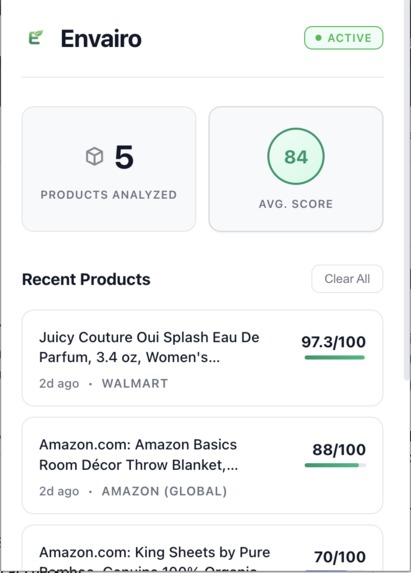
The Envairo popup showing previously scanned products and average sustainability score
-
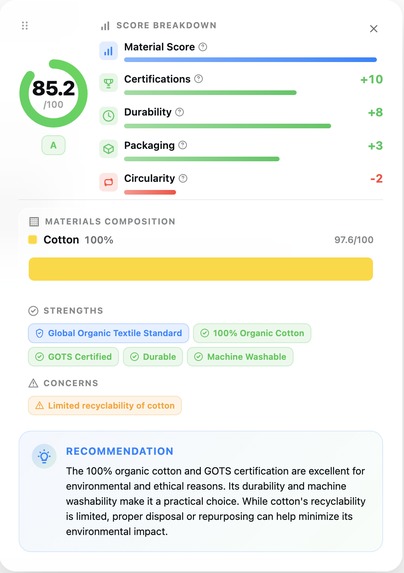
The Envairo overlay that appears on Amazon or Walmart product pages
-
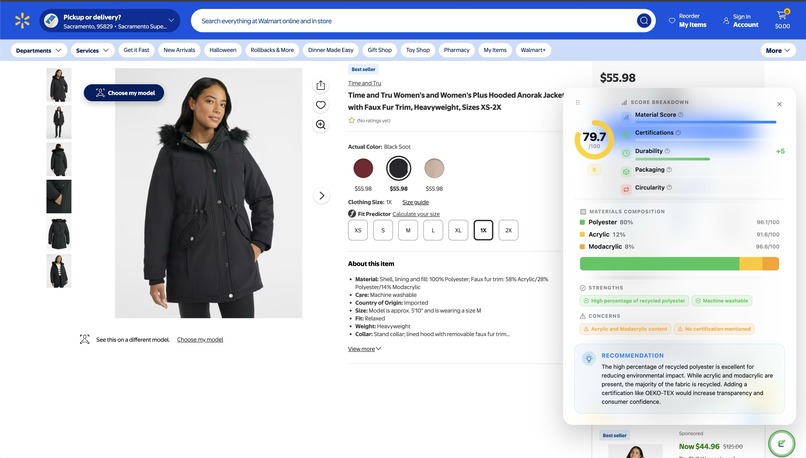
Walmart product page with Envairo analysis
-
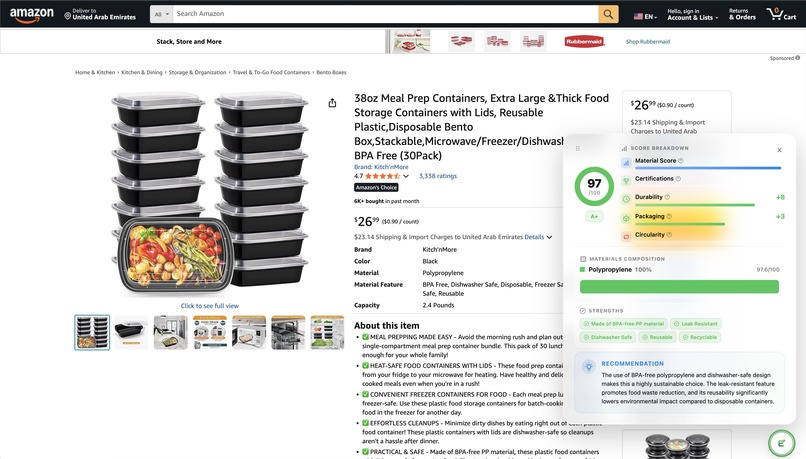
Amazon product page with Envairo analysis


Inspiration
Ever see a product labeled "eco-friendly" and wonder what that actually means? Consumers face vague marketing claims and confusing certifications with no easy way to compare products. Existing sustainability apps require email addresses, track browsing history, and collect personal data.
Chrome's Built-in AI changes this. Envairo analyzes products instantly and privately, right where you shop. It interprets complex material science and keeps your shopping habits completely private. Making sustainable choices shouldn't require a PhD or sacrificing privacy.
What it does
Visit any Amazon or Walmart product page. Within 5-10 seconds, a glass morphism overlay appears showing a sustainability score (0-100) with a letter grade (A+ to D). You see exact material breakdowns, detected certifications (GOTS, Fair Trade, OEKO-TEX, etc.), and AI-generated recommendations in plain English.
Envairo shows its work: an 88/100 score breaks down to 72 from materials, +8 for OEKO-TEX certification, +10 for durability features, -2 for non-recyclable components.
What makes it different? Instead of crowdsourced ratings or marketing claims, Envairo combines Chrome's Built-in AI with peer-reviewed research databases covering 200+ materials. Most importantly, it's 100% private. Everything happens on your device. Your shopping habits never leave your browser. No accounts, no tracking, just instant sustainability insights.
How we built it
Chrome Built-in AI (Gemini Nano) runs entirely in the browser with zero external API calls. The core innovation combines on-device LLM intelligence with peer-reviewed research databases for credible, private analysis.
Smart content extraction reduces product pages from 50-200KB down to 4-5KB of relevant information using intelligent scoring and pattern matching. This makes analysis 70% faster while staying within AI input quotas.
Configuration-driven architecture allows adding new sites in 20-30 minutes instead of weeks. Each site gets a simple JSON config with selectors and patterns, resulting in 64% less code than hardcoded approaches.
Prompt engineering precision with strict rules, multiple examples, and auto-validation solved the hallucination problem. Early versions claimed "5% zipper, 2% button" as materials. The system now achieves 98% accuracy in material extraction.
Technology stack:
- Chrome Prompt API (Gemini Nano) for analysis
- ES6 modules with dynamic imports
- Shadow DOM for CSS isolation
- Research databases: ICE v3.0, PlasticsEurope, USLCI, OWID
- Vanilla JavaScript (zero dependencies)
Challenges we ran into
AI hallucination. Early versions invented materials that weren't mentioned. "92% cotton, 5% zipper, 2% button" as if zippers and buttons were fabrics. Fixed with strict prompting ("ONLY extract materials explicitly mentioned"), multiple examples, and database cross-referencing.
Performance bottleneck. Initial version took 15-30 seconds because we sent 50-200KB of HTML to the AI. Built an intelligent extraction system that identifies relevant sections, reduced content to 4-5KB, and brought analysis time down to 5-10 seconds.
Scalability. The first version had 1,188 lines of hardcoded Amazon selectors. Rebuilt with a modular config system where each site is a JSON file. Adding Walmart took 25 minutes and resulted in 64% less code overall.
Model availability. Gemini Nano requires 22GB download and specific Chrome Canary flags. Created detailed setup documentation with troubleshooting guides to help judges test the extension.
Accomplishments that we're proud of
Solved AI hallucination from unusable ("5% zipper, 2% button") to 98% accuracy through careful prompt engineering. The AI now only extracts materials explicitly mentioned in product descriptions.
Built a production-ready tool, not just a demo. Complete with error handling, edge cases, URL change detection, keyboard shortcuts (Cmd+Shift+Y), draggable UI, product history tracking, and comprehensive documentation.
True privacy with zero compromises. 100% on-device processing, no external API calls, no data collection, no accounts. Your shopping habits never leave your browser.
Hybrid AI + science approach. Combines LLM intelligence for understanding product pages with peer-reviewed research databases for credibility. AI handles extraction, science provides scoring.
Performance optimization. Through intelligent content extraction and single-pass AI analysis, achieved 5-10 second response times (70% improvement over naive approach).
What we learned
Prompt engineering is precise work. Changing "extract materials" to "ONLY extract materials explicitly mentioned" improved accuracy dramatically. Small wording changes have massive impact on AI behavior. Adding three concrete examples in the prompt eliminated 90% of hallucinations.
Privacy matters to users. When you say "your shopping history never leaves your browser" and actually mean it, users notice and trust you. Zero data collection became a key differentiator.
Performance determines adoption. 15-30 seconds? People leave. 5-10 seconds? People wait. Speed is the difference between a cool demo and an actually useful tool.
Configuration-driven design pays off. Separating logic from data reduced code by 64% and made the system extensible. Non-developers can now contribute site configs.
Chrome's Built-in AI is powerful. On-device LLMs enable entirely new privacy-first applications. No servers, no tracking, just intelligent local processing.
What's next for Envairo
Expand to 10+ platforms. eBay, Etsy, Target, Shein. Each site takes 25 minutes with our config system. Community contributions could accelerate this significantly.
Product comparison mode. Side-by-side scores for similar items: "This costs 10% more but scores 25% better in sustainability. Worth it?"
Multimodal AI integration. Use Chrome's future image APIs to analyze product photos (packaging claims, certification labels, material textures).
Impact tracking. Personal stats showing "Your choices this month avoided 50kg CO2 emissions" with achievements and progress tracking.
AI-powered config generation. Users scan any product page and Prompt API auto-generates extraction configs, making it trivial to support new sites.
Manufacturer engagement. Show brands "X thousand users chose more sustainable alternatives" to create market pressure for better products.
The vision: Every purchase is a vote. Make those votes visible and easy, and markets shift toward sustainability. Not through guilt, but by making sustainable choices the obvious choice. One product at a time.


Log in or sign up for Devpost to join the conversation.